


New posts to come … if I can figure out how to do this
It’s time to re-activate my author blog
Posted by Lew Weinstein on April 19, 2024
Posted in *** Uncategorized | 2 Comments »
Announcing Lew’s 7th novel … AFTER AUSCHWITZ
Posted by Lew Weinstein on June 21, 2021
An overview of the trilogy
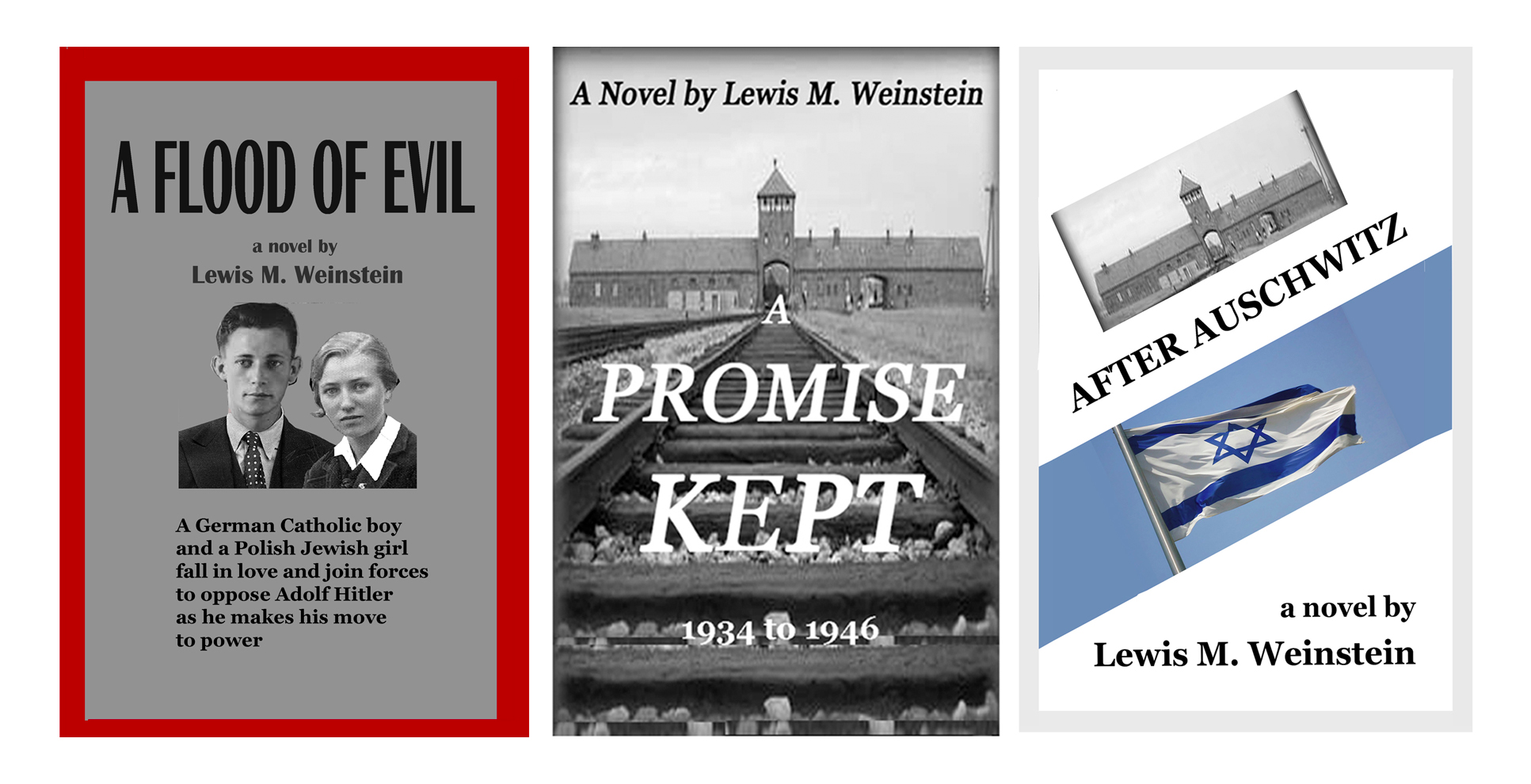
AFTER AUSCHWITZ completes a trilogy of novels which also includes A FLOOD OF EVIL and A PROMISE KEPT.
These three novels explore the unrelenting efforts of the German Catholic Berthold Becker and the Polish Jew Anna Gorska as they seek to oppose Hitler and his atrocities while also maintaining, often from afar, their intense love.
A FLOOD OF EVIL covers the years 1923 to 1933 as Berthold and Anna grow up in Munich and Poland respectively, meet and fall in love, and begin their efforts to tell the world what Hitler is about to do.
A PROMISE KEPT advances the story from 1934 to 1946, from Hitler’s early years of power through the war, the Holocaust, and the Nuremberg War Crimes Trials.
AFTER AUSCHWITZ explores the postwar lives of Berthold and Anna from 1946 to 1961, set mostly in Spandau Prison and the new State of Israel.
The first two novels also include scenes which take place in 1990, when Berthold and Anna look back and are finally able to tell their stories.
COMMENTS FROM EARLY READERS OF AFTER AUSCHWITZ
… I loved, loved, loved the book!! Thank you so much for writing it and also for allowing me to be an earlier reader!
… The book was very educational for me, while also a gripping read. I only wish I had paid more attention in history class! I think your novels should be required reading for all high school students.
… during one of Berthold’s garden conversations at Spandau you asked the most profound question: Is it possible that Hitler was using the diversion of war in order to carry out the mass murder of Jews, which had always been his higher priority? … Lew, chills went down my spine when I read those words! I’ve never heard anyone say that before … Dear God, what if it was a true statement?
… I finished the book, and enjoyed it very much. I found it to be very emotional, and I had to pause a lot to dry my eyes; Often it was the parts about the good in people that brought the tears, not the evil … but also I felt bad for the tragic misery of Berthold despite the fact that he did so much good at such danger to himself.
… Berthold’s prison sentence seemed so unfair, but in the end it seemed necessary for him to do more good, and to help with his eventual healing.
… I think the book is a great ending to the trilogy, and ties many things together, although it can also be read first or as a standalone.
… even some of the things I knew were fictional seemed real; such as the meetings with Elie Wiesel.
Posted in *** Uncategorized | 7 Comments »
another “SKYPE” book appearance (2/15/19)
Posted by Lew Weinstein on February 15, 2019
Sitting on my couch in Key West, doing a SKYPE book appearance at the JCC of Staten Island … great questions … I hope they enjoyed discussing THE HERETIC as much as I did … I’ll be pleased to “appear” at your book club by SKYPE to discuss any of my novels … contact me here, at Facebook, or by email at authorlewweinstein@gmail.com.
Posted in *** Uncategorized | 3 Comments »
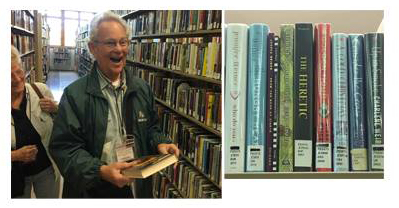
* Finding my first novel on the shelf at Princeton’s Firestone Library
Posted by Lew Weinstein on October 22, 2017
Posted in *** Uncategorized | 2 Comments »
* Lew’s review of “The German Resistance” by Gerhard Ritter
Posted by Lew Weinstein on August 15, 2017

***
This is one of several books I’m reading to understand the opposition to Hitler that came close to removing him in 1938. The cast of characters who made up the”opposition” was large and included very prominent Germans. They had a plan that might have worked but were undercut at the last minute when Chamberlain (British PM) caved to Hitler at Munich.
Ritter’s book tells this story in way that’s exciting even when you know the outcome. I’m hoping to do the same when I put my fictional character into the mix of conspirators in the sequel to A Flood of Evil.
Here are some excerpts from Ritter …
… in the army command of 1938, there was not the slightest desire to fight but only a universal apprehension of the possibility of a world war.
… a rebellion was actually prepared … in conjunction with a group of conspirators which had been formed within the counterintelligence service of the High Command.
… The most difficult thing was, of course, to seize the person of Hitler right away. Witzleben was ready personally to take on this task on condition that he got from Brauchitsch as Commander-in-Chief formal orders to occupy ‘the Government quarter’; if necessary the gates of the Chancellery would be blown up by artillery and Hitler taken prisoner. To prevent the intervention of the S.S., especially of the Leibstandarte Division stationed in Munich, an armoured division commanded by General Hoepner and then in Thuringia would be ready to move. It was left obscure what was to be done with Hitler when he had been removed from the Chancellery.
… Chamberlain flew to Munich and Berchtesgaden … Hitler now had his supreme diplomatic triumph; the Prime Minister of Great Britain visited him in person in his mountain fortress in order—as the world generally interpreted it—to beg of him peace. The conspirators in Berlin saw themselves foiled. The wild beast which they had meant to snare, had escaped the net.
Posted in *** Uncategorized | Leave a Comment »
A FLOOD OF EVIL … update on the sequel
Posted by Lew Weinstein on August 5, 2017

At this point in my draft of the sequel to A FLOOD OF EVIL (late 1937), Berthold & Anna are precariously positioned between Reinhard Heydrich, head of the Gestapo, and Hjalmar Schacht, who is on the verge of initiating an undercover movement to eliminate Hitler.
***
General Ludwig Beck, Chief of the German General Staff, prepared an extended critique of Hitler’s plan, arguing that Germany was not ready for a major war.
***
Berthold produced a copy of General Beck’s report, which Schacht read with great care, often turning back and forth to connect Beck’s various points.
“This is remarkable,” Schacht said when he finished. “Do you think Beck’s views have any chance?”
“No more,” Berthold said, “than your absolutely correct evaluation of the economic devastation Hitler is producing by focusing solely on rearmament. The Fuhrer has not been known to change his mind on any of the issues central to his agenda, which in turn has not changed since 1923.”
“So the only way to change the agenda is to change the Fuhrer,” Schacht said.
***
Posted in *** Uncategorized | 3 Comments »
* Lew featured on Karen Ingall’s blog
Posted by Lew Weinstein on July 24, 2017
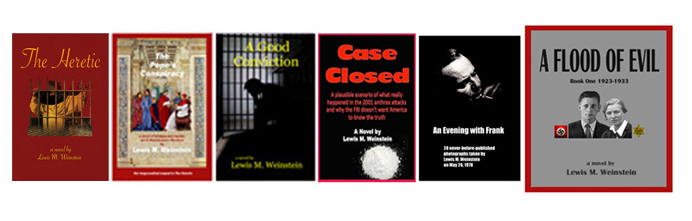
Karen Ingalls is featuring me this week on her MIND, PEN, AND SPIRIT blog
… thank you so much Karen
… http://kareningalls.blogspot.com/
I am pleased to welcome Lew Weinstein to my blog this week. He writes historical fiction based on thorough research. He has written five books. He pursued writing after a long career in management. His English teacher had always told him he had the gift for writing.
Posted in *** Uncategorized | Leave a Comment »
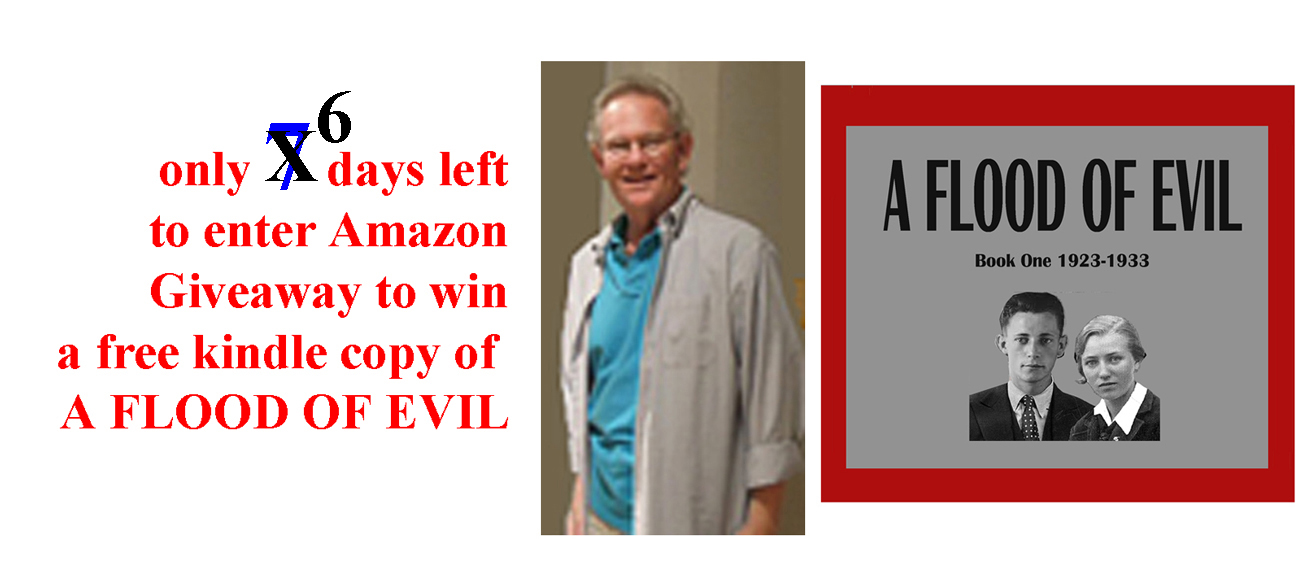
* only 6 days left
Posted by Lew Weinstein on July 14, 2017
Posted in *** Uncategorized | Leave a Comment »
* a reader’s review of A FLOOD OF EVIL … thank you Ann Marie
Posted by Lew Weinstein on July 9, 2017
***
Ann Marie rated A FLOOD OF EVIL *****
… it was amazing … In A Flood of Evil, Lewis Weinstein has written a novel that is both compelling and riveting
… The love, strength and courage between Anna, the Jewish journalist and Berthold, the German boy is a real page turner.
… The mix of historical facts and and realistic characters makes this a must read book.
Posted in *** Uncategorized | Leave a Comment »
* 10 days to go
Posted by Lew Weinstein on July 9, 2017
***
10 days to go … Amazon Giveaway … winners will receive a FREE copy of A FLOOD OF EVIL in kindle format … click to enter …
Posted in *** Uncategorized | Leave a Comment »
* Amazon giveaway … free copies of A FLOOD OF EVIL
Posted by Lew Weinstein on July 5, 2017

***
TO ENTER THE GIVEAWAY GO TO …
***
https://giveaway.amazon.com/p/32c9c736c8175c26#ts-afo
***
THEN CLICK … “Follow Lewis M. Weinstein on Amazon to continue”
***
Entry Deadline: Jul 20, 2017 11:59 PM PDT
Hosted by Lew Weinstein, author

Posted in *** Uncategorized | Leave a Comment »
* another look at what is IMO the very best book about writing fiction I have ever read
Posted by Lew Weinstein on July 4, 2017
***
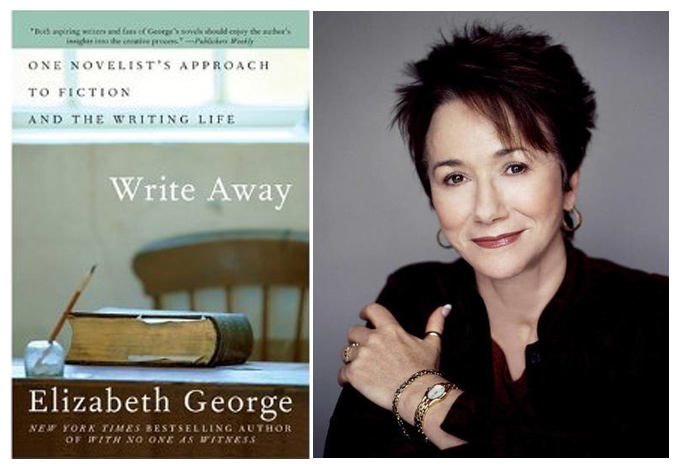
Every once in a while, I re-read Elizabeth George’s book, looking for refreshment of old lessons and new perspectives based on where I am in my own writing.
Here are my 2017 Elizabeth George refresher notes, along with some notes to myself …
-
Analysis of character is the highest human entertainment; each character is different and human character is the greatest of puzzles
-
What we take away from a good novel is mainly the memory of character
-
An event alone, nor a series of events, cannot hold a story together … only characters effecting events and events effecting characters can do that
-
Real people have flaws … are riddled with doubts … make mistakes … have lapses of judgment … experience weakness
-
Characters are interesting in their conflict, their misery, their unhappiness, their confusion … they are not interesting in their joy and security
-
Give characters flaws and self-doubts … put them into conflict … allow them to grow and change … LMW: characters may also regress
-
Create a written analysis of each major character … LMW: compare where Berthold & Anna are now with where they were before and where I expect them to be later
-
Look for opportunities to relate something about a character’s past … expand the reader’s understanding … do so through the character’s words and actions, not by telling about them
-
Personality quirks and telling details can have great cumulative impact on the reader’s perception of that character
-
Create atmosphere … setting triggers mood … a character’s environment shows who he is … everything else is interpreted by the reader
-
Your setting should be a place you and the reader want to know more about … LMW: Warsaw and Berlin in the 1930s … Auschwitz & Dachau … not a travelogue but as Berthold & Anna see them
-
In rendering a setting, rely on telling details … put your place into action … details in motion
-
Setting used to its fullest can elevate an ordinary scene into one which is unforgettable
-
Use the climate of a location … weather, sounds, scents, animals … stimulate the reader’s senses and imagination
-
Every person has an external landscape … a certain look, a way of acting, clothes, a house or office … all can pass information about the character to the reader … use specific and telling details … LMW: use Berthold’s SS uniform as a continuing motif
-
A character’s internal landscape is revealed in momentary reflections … also longer monologues (whether spoken or thought), letters, diary entries
-
Anything in a character’s environment can serve as an indicator of his internal landscape … LMW: Berthold’s recurring experiences of death … Dietrich … Mueller
Posted in *** Uncategorized | Leave a Comment »
* the powerful themes in A FLOOD OF EVIL make for a great conversation
Posted by Lew Weinstein on July 3, 2017
***
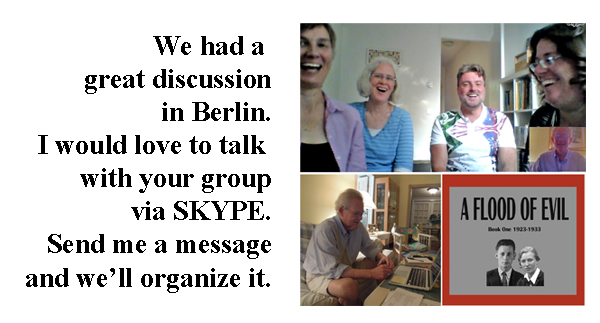
I was thrilled today to have a 90 minute conversation with Julia, Petra, Patrick, and Diana, all of whom offered thoughtful observations on the various core themes with which my characters in A FLOOD OF EVIL struggle.
The group began with the observation that my book was in many ways different from the tens of thousands of histories and novels which have been written on the Nazi period. In particular, there was an appreciation for the way I structured the book to show how and why many Germans were both enamored by and trapped into acceptance of Hitler.
Most books, they said, begin chronologically close to the concentration camps and mass murder; yours begins much earlier (1923) and shows how those things gradually became possible. You also showed through your German characters a recognition of the fact that all Germans cannot be lumped together into a single set of common understandings and motivation.
It was in fact one of my most important writing objectives to show each German character facing the Nazi challenge in his or her own particular way.
***

to arrange your own book discussion …
send me an email at authorlewweinstein@gmail.com
Posted in *** Uncategorized | Leave a Comment »
* a review of A FLOOD OF EVIL posted on amazon … thank you Carole
Posted by Lew Weinstein on June 30, 2017
***
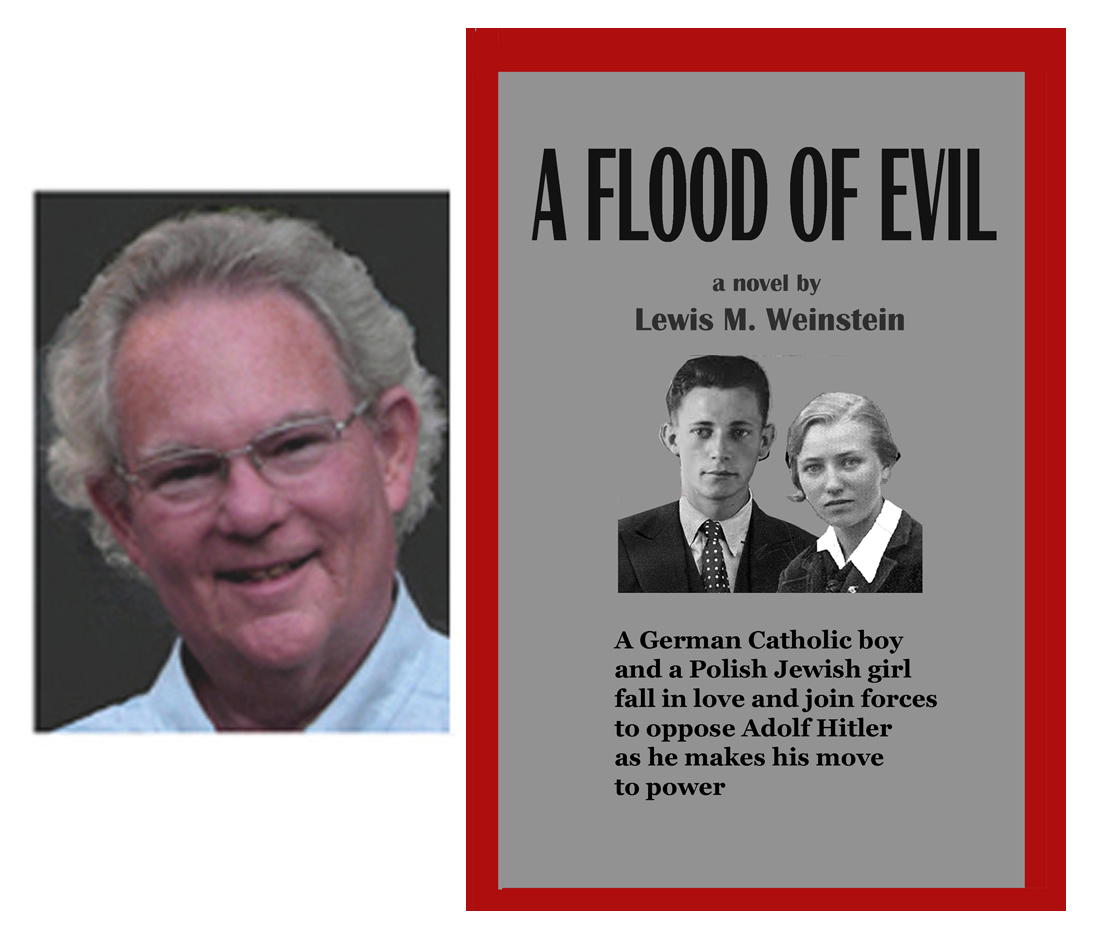
Meticulously researched, A Flood of Evil is a comprehensive novel that takes the reader step by step through the events that lead to the Nazi party’s rise in Germany. Told through alternating points of view, one gets a personalized account of how humanity was driven to the utmost stage of barbarity.
Berthold is a young German boy, caught in the Nazi limelight when his fanatical brother is killed in Hitler’s failed Munich putsch. Anna is a fearless young Polish Jew who is just starting out in life as a reporter for a Yiddish paper that reports to the world.
Circumstances throw them together and the book begins with Berthold being tried at Nuremberg for war crimes. Anna testifies that he saved so many Jewish lives as well as her own and must not be condemned, that he is no more guilty than the countries who failed to save the Jewish population, knowing what was going on inside Germany.
Years later, the daughter of the prosecutor wants to know the whole story, and bit by bit, it is told through both Berthold’s and Anna’s eyes.
Weinstein shines in his ability to explain the mindset of the people living, the how’s and why’s of the rise of the Nazi party. He painstakingly recreates the life and times, the political climate and the people caught up in the coming conflagration. Why did they stay? Didn’t they see it coming?
Like Leon Uris in Exodus, Weinstein is able to place the reader in the 1930’s where they can see it through the character’s viewpoint and understanding, without sacrificing story lines. Powerful and compelling, this is a must-read that puts history into perspective with both realism and sensitivity.
Posted in *** Uncategorized | Leave a Comment »
* recently posted comments (on FB) about A FLOOD OF EVIL … thank you Rebecka
Posted by Lew Weinstein on June 30, 2017
***
I loved reading it. For years, Holocaust studies have emphasized the statistics, the count of the dead and methods of humiliation and death. Lew’s book intimately involves the reader in understanding the challenges for every day citizens, whether Jewish or not.
Then he employed the romantic techniques of successful novelists to keep us turning the pages and deftly drew scenes that will stay with you. Along the way Lew has included so many historical details, you may be tempted to forget that this story didn’t really happen. I suspect many did have similar experiences, nothing in life is black and white.
Recent documentaries have shown just how messy the reality was. In some ways, we have near clarity now. But, we must never forget!
Posted in *** Uncategorized | Leave a Comment »
* Book Club in Berlin … Germans react to A FLOOD OF EVIL
Posted by Lew Weinstein on June 29, 2017
***
I am preparing for a book club meeting next week, in Berlin via Skype. I am very much looking forward to reactions to my book from Germans, all of whom have parents and grandparents who lived in Germany in the Nazi years.
The following questions have been suggested, but there is no telling where the discussion will go.
Q for me
* why did you choose this subject?
* how do you do your research?
* you began writing relatively late in life – what prompted you?
* what is most difficult for you in writing?
* when will the sequel be completed?
Q for group
* did you learn about Hitler & the Holocaust in school?
* did you learn anything different from my book?
* do you think the facts in AFOE are accurate?
* do you think the treatment is fair?
* what are you looking for in the sequel?
* what are your expectations (in the sequel) for Berthold? for Anna?
Posted in *** Uncategorized | Leave a Comment »
* Lew’s review of “The Holocaust in History” by Michael Marrus
Posted by Lew Weinstein on May 24, 2017

My brilliant marketing professor at the Harvard Business School (Ted Levitt) often reminded us “if you don’t know where you are going, any road will take you there.” This is particularly crucial as I move into those aspects of my novel where my fictional characters Berthold Becker and Anna Gorska react to the persecution of Jews and try to tell the world so that those who had power would act to stop Hitler before he accomplished his goal of total annihilation.
Michael Marrus’ book, published in 1987, is the best outline I have read of the origins and evolution of what Karl Schleunes called the “twisted road to Auschwitz”. So I think I have my best understanding yet as to where my characters are going to go, and thus I have guidance for the road(s) they will take and how they will fare along the way. This is an exciting moment for me as I plan my work for the months ahead.
Since I started A Flood of Evil with the 1945 trial of Berthold at Nuremberg, and since everyone knows about the Holocaust, the essence of my story in the sequel I am now writing (covering the years 1934 through 1945) must be the journey, and since Hitler was not stopped during those years, it must in many ways be a journey of failure … but … may it not be true that the greatest humanity of which we are capable arises, not from our successes, but from our failures?
MORE TO COME …
Posted in *** Uncategorized | Leave a Comment »
* Lew’s review of ALL THE LIGHT WE CANNOT SEE
Posted by Lew Weinstein on May 13, 2017

***
This is a magnificent book, as has already been affirmed countless times. So what can I add? The answer is that I can share what I learned from reading it, with the goal of improving my own writing.
Consider for example the meticulous sequencing of scenes, whereby Doerr often requires the reader to hold a prior scene in memory until the thread is picked up much much later. In lesser hands, this could be infuriating, but here it works brilliantly, and the prior action comes back easily when later invoked. I want to study this book to understand how Doerr has done this and why it works.
Consider also the many different approaches Doerr uses to structure his mostly short scenes, often in delightfully unexpected ways. Consider the careful choice of exactly the right word to describe a character or a setting. It is not likely that this happened in first drafts. It results from an unhurried process of writing, editing, thinking and adjusting.
It is quite understandable to me that Doerr took 10 years to craft this novel. He must have read and re-read many times, repeatedly changing words, plot lines, and scene sequences to achieve the effect he was seeking. To me both the story and the writing of it are inspiring.
Posted in *** Uncategorized | 3 Comments »
* another book on amazon’s German site with a swastika on the cover … why this one and not mine? … NOTE: Bezos has not responded to my earlier questions
Posted by Lew Weinstein on May 13, 2017

***
DEAR MR. BEZOS
I was just made aware of a new book (Hitler’s American Model), published in 2017, which is listed on amazon in the US and in Germany, which has a swastika on the cover. Can you please explain to me why that book (and many others on both sites) may have a swastika and mine (A FLOOD OF EVIL) cannot?
no swastika allowed … https://www.amazon.com/Flood-Evil-Lewis-M-Weinstein-ebook/dp/B01GQUC9KQ/ref=tmm_kin_swatch_0?_encoding=UTF8&qid=&sr=
LEW WEINSTEIN
Posted in *** Uncategorized | Leave a Comment »
* one month and no response from Mr. Bezos …
Posted by Lew Weinstein on May 7, 2017
He’s a busy man … this is a small matter in his universe … I shall be patient
Posted in *** Uncategorized | Leave a Comment »
* Dear Mr. Bezos …
Posted by Lew Weinstein on April 8, 2017
Dear Mr. Bezos,
I believe I have been treated in an appalling manner by the Contents group within Amazon’s Create Space. This is so contrary to every other experience I have had with Amazon that I thought you would like to know what happened and take appropriate action. I apologize for the length of this email, but the detail included will give you an idea of what I was dealing with and the level of frustration that resulted.
Let me say first that I love Amazon. I use Create Space and Kindle Publishing and am thrilled with the way you permit me to be a published author with all that means. I am also a Prime member and purchase just about everything from amazon, and have for years.
My novel A FLOOD OF EVIL was first approved by both Create Space and Kindle Publishing, and then suppressed. The extensive correspondence presented below, accumulated over many hours and days of frustration, describes what happened and the basic questions which remain unanswered: Why was my book suppressed? What prompted the suppression? Why was I not notified?
To which I would add … Do you agree I was mistreated by Amazon?
Here are the facts …
1. I published my 5th novel in June, on both Create Space and Kindle. A FLOOD OF EVIL (AFOE) is set in Germany and Poland in the 1920s and 1930s. It tells the story of two young people, a German Catholic boy and a Polish Jewish girl, who fall in love and devote their efforts to trying to prevent Hitler from reaching power.
2. AFOE was reviewed and approved for publication in June 2016, with no issues noted.
3. Sometime in early October 2016, AFOE was removed from publication on your German site. I was not notified of the removal.
4. In early March 2017, while I was arranging a book club meeting in Berlin, I checked the German site (amazon.de) and learned for the first time that my book had been “suppressed” and removed.
5. I contacted Create Space and received no explanation for what had caused the removal nor any advice as to how to restore it. I was told it was the Contents group which had removed it, but that neither I nor Create Space Customer Service (CSCS) – btw always terrific to deal with – could actually ever speak with the “unreachable” Contents people.
6. Meanwhile, AFOE was, in early March 2017, also removed from the US site (amazon.com), again without notification or explanation.
7. After several increasingly contentious interactions, it was suggested by CSCS that perhaps the swastika on the cover of AFOE was the problem, although of course this was not mentioned when the cover was approved in June.
8. I received the following email from CSP Tier 3 info3@createspace.com on March 13, 2017 … “I’m unable to provide specific information about the suppressions. The only information I’ve received from the Content Validation’s team is the one related to the swastika as the suppression reasons for October and March for the paperback. Regarding the Kindle edition, I’m unable to get information from them about any suppression. … In terms of the Content Guidelines, we have them in our site. However, we are unable to provide specific information about the possible rejections. If you have questions, you can reach the Content Validation team for this. I understand about the notifications and I’ve submitted feedback about it. I’m unable to get more information as to why it wasn’t sent. Please feel free to contact them directly at validation-request@createspace.comwith any additional questions.”
9. I responded as follows in an email also dated March 13, 2017 … “I appreciate your efforts but you must realize that your answers are inadequate and insulting. You suppressed my new novel for months and you provide no notification or explanation. I think amazon should be ashamed. I will take this further.”
10. On my own initiative, still without instructions from anyone at Create Space or the Contents Group, I submitted a new cover without the swastika and AFOE was within a few days returned to all sites.
11. As instructed, I sent an email to the Contents group dated March 14, 2017 … Content Validation Request validation-request@createspace.com … regarding CreateSpace Support Request / Case #06176858 … “Below you will find an email from Create Space Support advising me to contact Content Validation regarding the unanswered questions related to the suppression of A FLOOD OF EVIL on amazon.defor over 4 months and subsequently on amazon.comfor several days. … I am told that Create Space Support was unable to obtain answers from Content Validation and that I should contact you directly. … My questions can be summarized as follows: 1. What specific guideline did my original cover, which you approved in June 2016, violate? 2. What happened in October 2016 (.de site) and in March 2017 (.com site) to cause my book to be suppressed? Thank you for your attention to these questions.”
12, Meanwhile I did get an answer of sorts from Kindle Direct Publishing title-submission@amazon.com dated March 16, 2017 … “We take violations of laws and proprietary rights very seriously. It is your responsibility to ensure that your content doesn’t violate laws or copyright, trademark, privacy, publicity, or other rights. Just because content is freely available does not mean you are free to copy and sell it. In accordance with German law, we cannot publish content that displays swastikas.”
13. I regard this March 16 answer from Kindle as both arrogant and incorrect, as well as nasty, blaming me for not knowing information you did not make available and which is also incorrect. … My original cover was approved by both Kindle and Create Space. … Here are 3 problems with the Kindle March 16 response … (1) Amazon’s guidelines do not mention swastikas. (2) German law provides exceptions regarding swastikas which would seem to exempt my book from coverage. (3) The amazon .de site contains many book covers that contain swastikas. … more about these problems later.
14. Back to the Contents group … As of this date (April 7, 2017), I have never had the courtesy of answers as to what prompted the removal of my book from either the .de or .com sites … or why neither Create Space or Kindle Publishing failed to notify me of such “suppression.”
15. I did receive a very nice communication (March 21, 2017) from Jeremy Stoffel at Executive Customer Relationsecr@createspace.com … “Thank you for taking the time to talk to me this afternoon. I’ll make sure that your voice is heard regarding the feedback you gave me. I have created order number 164773070 for ten copies of the book with a new cover and they will arrive on March 29th. Please feel free to follow up with any additional questions you make have.”
16. I have received the 10 copies. Thank you.
17. Please note that neither amazon guidelines nor German law specifically prohibit swastikas on book covers, and amazon’s site contains many, including these …
https://www.amazon.de/Rise-Fall-Third-Reich-History/dp/1451651686/ref=sr_1_1?ie=UTF8&qid=1491327059&sr=8-1&keywords=The+Rise+and+Fall+of+the+Third+Reich%3A+A+History+of+Nazi+Germany+by+William+L.+Shirer
https://www.amazon.de/John-Toland-Author-Adolf-Hitler/dp/B018IOXR8G/ref=sr_1_11?ie=UTF8&qid=1491327233&sr=8-11&keywords=hitler+john+toland
https://www.amazon.de/Dictionary-Third-Reich-Penguin/dp/0140513892/ref=sr_1_3?ie=UTF8&qid=1491327313&sr=8-3&keywords=The+Penguin+Dictionary+of+the+Third+Reich+by+James+Taylor
https://www.amazon.de/Third-Reich-Victorious-Alternate-Decisions/dp/0345490150/ref=sr_1_1?ie=UTF8&qid=1491327440&sr=8-1&keywords=Third+Reich+Victorious+Tsouras
https://www.amazon.de/Propaganda-German-Cinema-1933-1945-Society/dp/1860645208/ref=sr_1_1?ie=UTF8&qid=1491327526&sr=8-1&keywords=The+Third+Reich+by+David+Welch
https://www.amazon.de/The-Third-Reich-in-Power/dp/B00NTQ3GIK/ref=sr_1_2?ie=UTF8&qid=1491327686&sr=8-2&keywords=Evans%2C+Richard++%09The+Third+Reich+in+Power
18. German Law regarding swastikas … The GermanStrafgesetzbuch(Criminal Code) in § 86a outlaws “use of symbols of unconstitutional organizations” outside of the contexts of “art or science, research or teaching”. This concerns Nazi symbolism in particular and is part of the denazification efforts following the fall of the Third Reich. The law prohibits the distribution or public use of symbols of unconstitutional groups–in particular, flags, insignia, uniforms, slogans and forms of greeting.[1] … (3) Subsection (1) shall NOT BE APPLICABLE if the means of propaganda or the act serves to further civil enlightenment, to avert unconstitutional aims, to promote art or science, research or teaching, reporting about current historical events or similar purposes. […]
***
As stated above, my basic questions remain unanswered: Why was my book suppressed? What prompted the suppression? Why was I not notified?
Again repeating what was said above … Do you agree I was mistreated by Amazon?
Hoping to hear from you, and still a loyal Amazon customer, I remain …
LEWIS M. WEINSTEIN
Posted in *** Uncategorized | 4 Comments »
* What readers say about A FLOOD OF EVIL …
Posted by Lew Weinstein on March 18, 2017
***
What readers say about A FLOOD OF EVIL …
… Very few writers can successfully write historical fiction as compellingly as Lewis M. Weinstein.
… This is one of the best books I have ever read! It is historical fiction of the highest order.
… Weinstein brings the rhetoric of hatred, fear and abuse of power of the Hitler Regime to life in the personal love story of two young people.
… The characters are so realistic it is easy for the reader to become involved in their lives.
… There is literally never a dull moment in the book.
… The author’s research on so many levels was mind boggling.
… His style of writing draws you in to the room and you feel sometimes like you are another character in the corner.
… a powerful and complex story about love, fear and the corrosive abuse of political power
Posted in *** Uncategorized | Leave a Comment »
* more on the “suppression” of A FLOOD OF EVIL by Amazon in Germany and the US
Posted by Lew Weinstein on March 16, 2017

My questions to Kindle Support services …
1. I did not find any guideline that mentions swastikas … did I miss this guideline?
2. What happened in October 2016 (.de site) and in March 2017 (.com site) to cause my book to be suppressed after it had been approved in June 2016? Somebody decided to take action. Why?
Kindle Support services response
We take violations of laws and proprietary rights very seriously. It is your responsibility to ensure that your content doesn’t violate laws or copyright, trademark, privacy, publicity, or other rights. Just because content is freely available does not mean you are free to copy and sell it. In accordance with German law, we cannot publish content that displays swastikas. I’m so sorry, but we can’t offer any additional insight or action on this matter.
Current Status
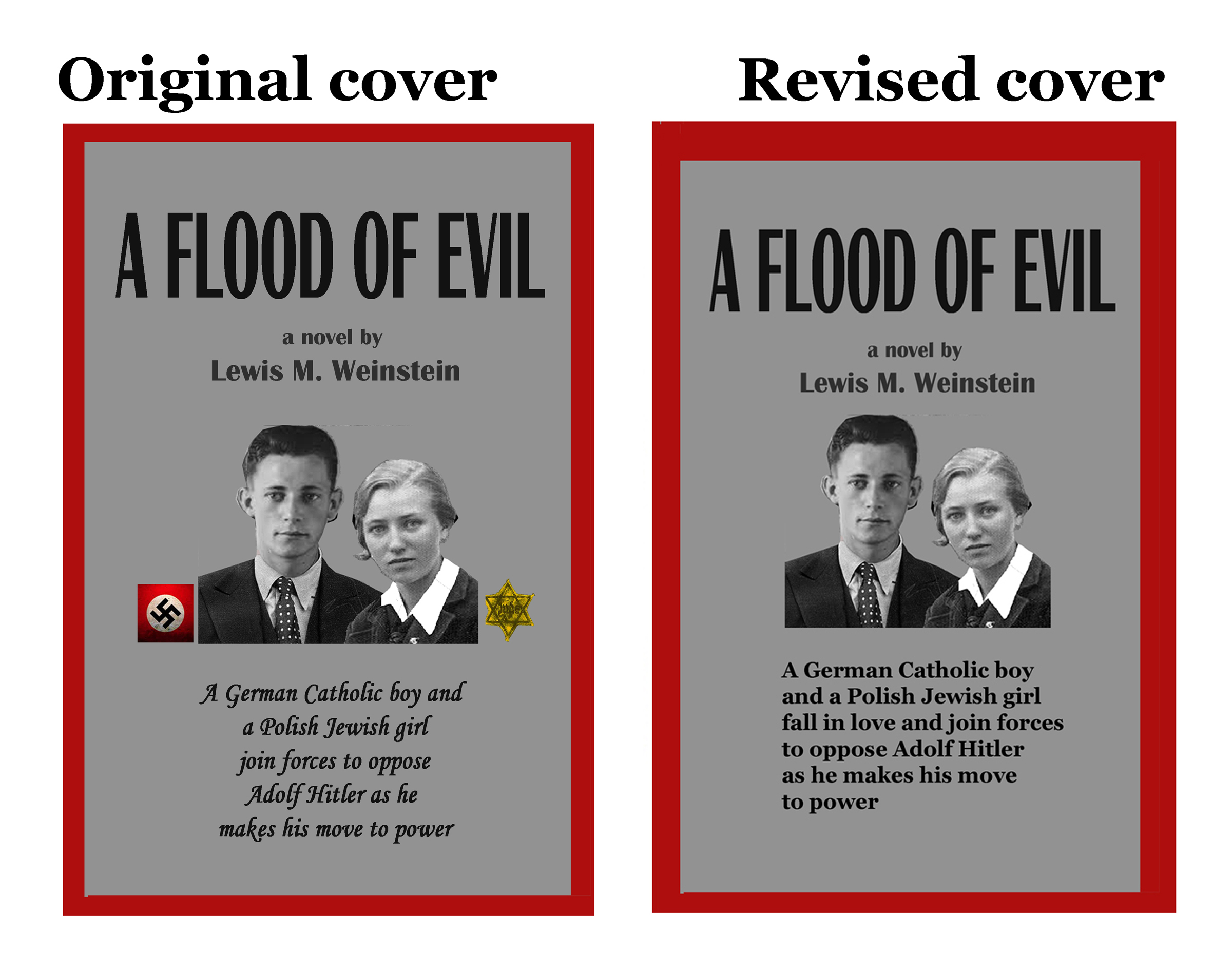
Several days ago, I changed the cover to remove the swastika, and AFOE was restored to both the German and US sites.
Posted in *** Uncategorized | Leave a Comment »
* “BANNED IN GERMANY” is now part of AFOE book descriptions on Amazon & Goodreads
Posted by Lew Weinstein on March 14, 2017
***
BANNED IN GERMANY …
From early October 2016 to mid-March 2017, A FLOOD OF EVIL was “suppressed” in Germany, unavailable for purchase. I was never notified that my book was no longer for sale in Germany. When I found out, by accident, Amazon refused to say why the book was suppressed, and also refused to say what prompted the suppression. After several days of fruitless back and forth, I changed the cover to remove a small swastika and the ban was lifted.
A FLOOD OF EVIL tells the story of German Catholic boy from Munich who becomes a Nazi and a Jewish girl from the Polish shtetl of Ciechanow who becomes an internationally known journalist. Improbably, they fall in love and join forces to try to stop the rise of Hitler. The story covers the years 1923-1933, and a sequel set against the events of 1934-1945 is currently being written.
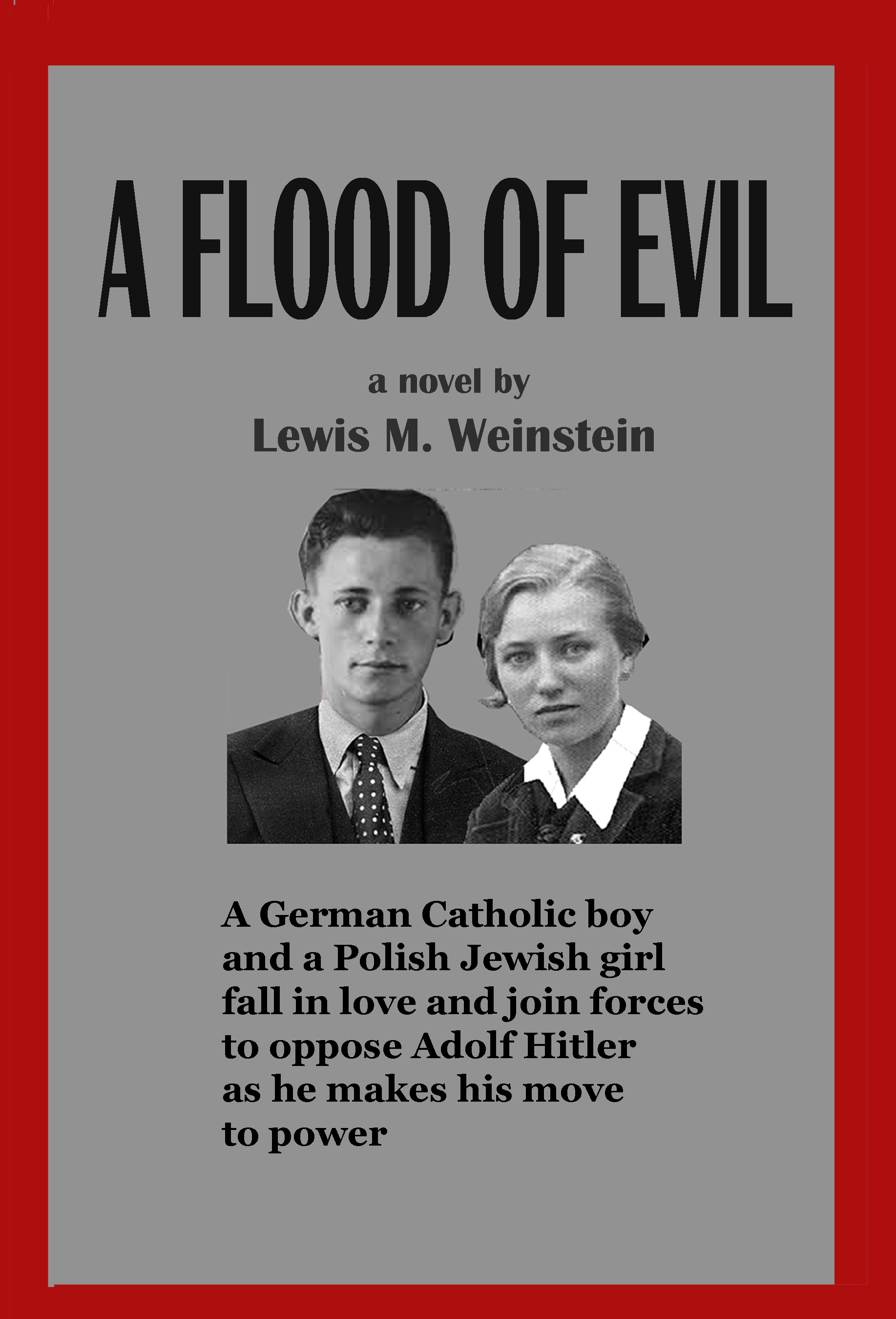
On the original cover of AFOE, the Nazi/Jewish theme was illustrated graphically by a small swastika next to the boy and a small Jewish star next to the girl. These symbols have now (I hope temporarily) been removed. I am still trying to find someone in amazon management who will recognize and deal with what I regard as the extremely shoddy way I was treated.
***
NOTE: this description is now “live” at Goodreads but not yet at Amazon
Posted in *** Uncategorized | Leave a Comment »
* I will be calling amazon management about the 4 month “suppression” of A FLOOD OF EVIL in Germany
Posted by Lew Weinstein on March 13, 2017
I will be calling amazon and will try to raise the behavior of some of their people to an appropriate management level review. The people I was able to talk with, on the phone or by email, were uniformly understanding and sympathetic, but somewhere behind them, unreachable to me, were people who made decisions they do not want looked at too closely, which is why they have refused to answer my questions.
But I will continue to look, and if I can get amazon management to also look, I think they will be appalled.
Btw, I am a real amazon fan. Amazon has helped me publish and sell my books, and I am also a very happy prime customer for a wide variety of products. What these few amazon employees did to me is not typical of the company, and I feel certain that, at the end of the day, amazon management will do what’s right.
Posted in *** Uncategorized | 1 Comment »
* amazon refuses to provide answers as to why AFOE was “suppressed” on German and US sites … they should be ashamed
Posted by Lew Weinstein on March 13, 2017
***
Received from amazon today …
I’m unable to provide specific information about the suppressions. The only information I’ve received from the Content Validation’s team is the one related to the swastika as the suppression reasons for October and March for the paperback.
Regarding the Kindle edition, I’m unable to get information from them about any suppression. In terms of the Content Guidelines, we have them in our site: https://www.createspace.com/Help/Rights/ContentGuidelines.jsp. However, we are unable to provide specific information about the possible rejections if you have questions, you can reach the Content Validation team for this.
I understand about the notifications and I’ve submitted feedback about it. I’m unable to get more information as to why it wasn’t sent.
My response …
I appreciate your efforts but you must realize that your answers are both inadequate and insulting. You suppressed my new novel for months and you provide no reasons or explanation. I think amazon should be ashamed. I will take this further.
Posted in *** Uncategorized | 1 Comment »
* my post on the Goodreads Jewish Historical Fiction site regarding the banning of AFOE in Germany
Posted by Lew Weinstein on March 13, 2017
Posted to Jewish Historical Fiction site … https://www.goodreads.com/group/show/6449-jewish-historical-fiction …
My historical novel A Flood of Evil was BANNED IN GERMANY from early October until yesterday.
Amazon apparently made that decision based on the small swastika on the cover, since removed. (NOTE: my novel is surely not pro-Nazi; quite the opposite.)
Amazon never notified me that my book was removed from their site. I found out by accident when checking the amazon.de site in preparation for an upcoming book club meeting in Germany (via SKYPE).
The Amazon guidelines are not clear. There is no explicit guideline regarding swastikas. There are other books on Amazon’s German site which display swastikas.
Needless to say, I am furious with Amazon for the inconsiderate and discriminatory way they treated me and for the damage they caused me. Among other things, it was impossible to speak directly with the Contents people who made the decision to ban my book, which made resolution doubly difficult.
I would like to know if anyone knows of similar treatment of other books.
Posted in *** Uncategorized | Leave a Comment »
* AFOE is up on Amazon’s German site (and all other Amazon sites), in both print and kindle versions
Posted by Lew Weinstein on March 12, 2017
***
Finally! Now all I want to know is why this happened and why I was never notified by Amazon.
Posted in *** Uncategorized | Leave a Comment »
* AFOE back on Amazon’s US site
Posted by Lew Weinstein on March 11, 2017
Hoping to be on German site later today.
Posted in *** Uncategorized | Leave a Comment »
* issues with AFOE cover on amazon are being resolved
Posted by Lew Weinstein on March 10, 2017
***
It appears the the only issue was the swastika on the cover. I have submitted a revised cover (see above) and expect that AFOE will be restored to all amazon sites in another day or so.
Remaining issues to be resolved with Amazon …
-
Why was I not notified in early October when AFOE was “suppressed” from amazon.de?
-
Why was AFOE “suppressed” from amazon.com on March 8, again without any notification?
Posted in *** Uncategorized | Leave a Comment »
* AFOE Update … March 9 10:30am
Posted by Lew Weinstein on March 9, 2017
AFOE UPDATE …
Amazon Kindle Support has answered regarding the withdrawal of AFOE from Germany, stating that it was the swastika. I will now change the cover.
I have also submitted a revised cover for the print edition to Create Space Support, although they have yet to answer any of my questions.
Posted in *** Uncategorized | Leave a Comment »
*AFOE in print format is still banned from all Amazon sites; it is also banned in kindle format from Amazon’s German site
Posted by Lew Weinstein on March 9, 2017
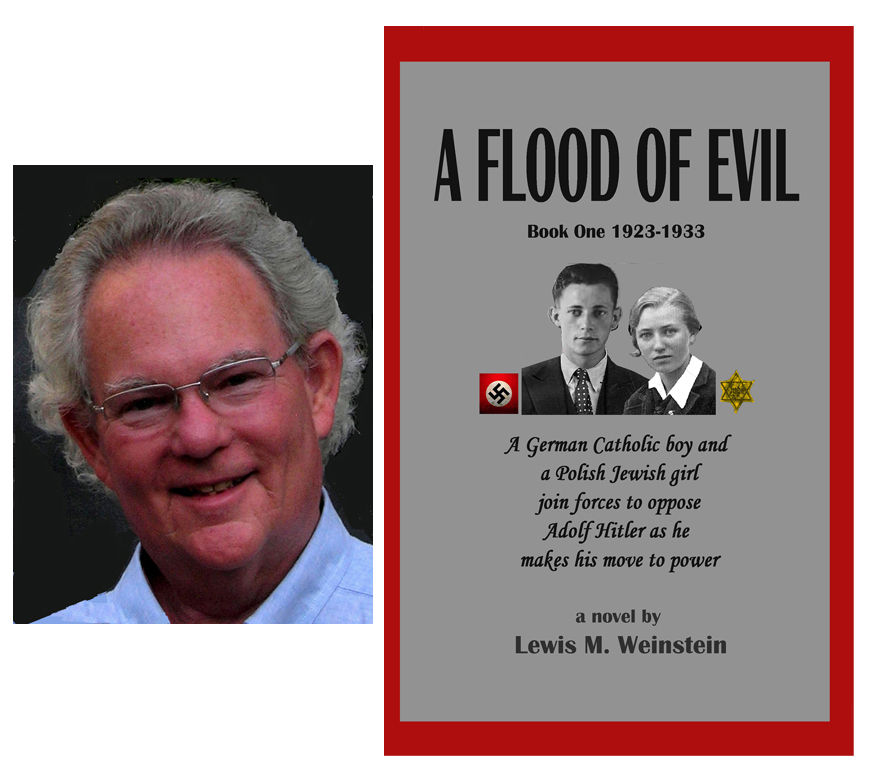
There are four unanswered questions before Amazon Create Space …
-
Is the swastika on the cover the only reason for the suppression?
-
Would be acceptable to upload a new cover with the swastika removed under the same title ID and ISBN?
-
Is the Jewish star with the inscription “jude” allowed?
-
Why was the book removed from Amazon.com as well?”
A separate question has been sent to Amazon Kindle Support …
5. Why has AFOE been removed from the amazon.de (the Amazon German site)?
***
A FLOOD OF EVIL is available in both print and NOOK versions from Barnes & Noble …
http://www.barnesandnoble.com/w/a-flood-of-evil-lewis-m-weinstein/1123905383?ean=9781494295783
Posted in *** Uncategorized | Leave a Comment »
* AFOE banned in Germany – update March 8 (noon)
Posted by Lew Weinstein on March 8, 2017
***
an email from Amazon Create Space customer service …
Hello Lewis,
Per our conversation, I am submitting your request with my call notes to our content team asking the following:
– If the swastika is the only reason for the suppression
– If it would be acceptable to upload a new cover with the swastika removed under the same title ID and ISBN
– If the Jewish star with the inscription “jude” is allowed
You should be hearing back from this team within the next one to two business days with their response.
In the meantime, please do try to have a better day.
Posted in *** Uncategorized | 2 Comments »
* AFOE BANNED – update March 8 10:00 am
Posted by Lew Weinstein on March 8, 2017
***
The print edition of A FLOOD OF EVIL has subsequently been removed from all Amazon sites, although it is still available in kindle format.
AFOE is still available, in both print and NOOK formats, on Barnes & Noble at …
http://www.barnesandnoble.com/w/a-flood-of-evil-lewis-m-weinstein/1123905383?ean=9781494295783
Posted in *** Uncategorized | Leave a Comment »
* A FLOOD OF EVIL is banned in Germany!
Posted by Lew Weinstein on March 8, 2017
***
I have been having discussions regarding a possible book club appearance to be arranged in Germany, in the course of which I checked amazon.de, amazon’s German web site. I was shocked to find that A FLOOD OF EVIL was not listed.
Upon inquiry, I received an email from Amazon which stated that AFOE had been “suppressed” in Germany. Subsequent correspondence with Amazon yielded the following explanation: “During the review process, your work was found to contain material, which may include cover image, title and/or product descriptions or interior content, that is in violation of CreateSpace content guidelines for Germany and may infringe German law.”
That was it. No details. No indication of what content was objectionable. No statement of what guideline was violated.
It should be noted that the entire book, including the cover, had been approved by Amazon when it was submitted. No one said anything was objectionable. AFOE was initially available on all Amazon sites, including in Germany. I don’t know exactly when it was removed. No one ever had the courtesy to tell me when it was removed.
Obviously, I am furious and trying to deal with Amazon to get this situation resolved.
Posted in *** Uncategorized | Leave a Comment »
* excerpts from a new amazon review of A FLOOD OF EVIL
Posted by Lew Weinstein on February 16, 2017
***
“A Flood of Evil” by Lewis M. Weinstein is well written and meticulously researched. Weinstein has a writing style that draws the reader into the scene. This is a complex story about the organized systematic hatred of one group of people. Weinstein brings the rhetoric of hatred, fear and abuse of power of the Hitler Regime to life in the personal story of two people. The characters are so realistic it is easy for the reader to become involved in their lives. I am impressed with Weinstein’s writing skills.
***
A FLOOD OF EVIL is available on amazon in print and kindle formats …
Posted in *** Uncategorized | Leave a Comment »
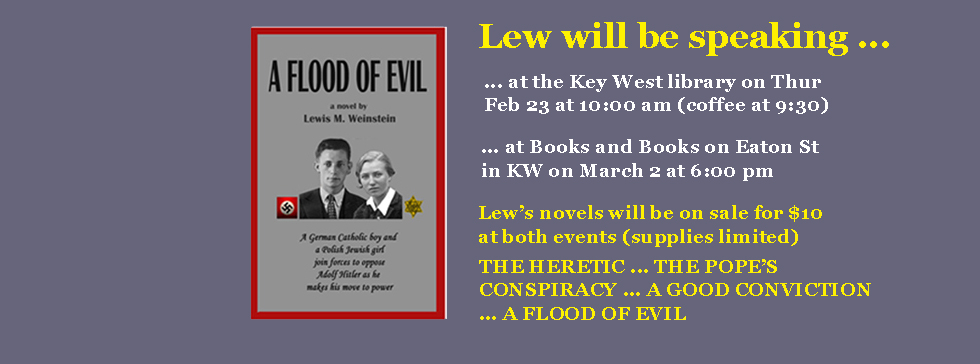
* Lew will be speaking in Key West
Posted by Lew Weinstein on February 8, 2017
Posted in *** Uncategorized | Leave a Comment »
* schedule a book club meeting with Lew
Posted by Lew Weinstein on January 26, 2017
***
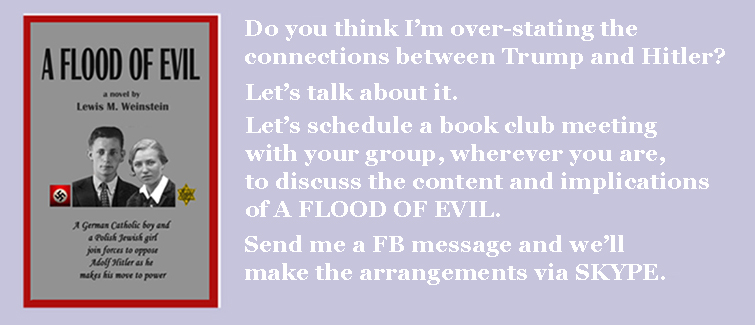
Book club meetings by SKYPE are a great way to have exciting meetings when distances do not permit my personal attendance. It has proven quite simple to make the arrangements. At the club site, the video can be projected onto a TV screen.
If this sounds interesting to you, contact me at lmwkwhome@gmail.com and we can discuss a schedule and arrangements.
***
A FLOOD OF EVIL is available
in print and kindle formats at amazon …
Posted in *** Uncategorized | Leave a Comment »
* a new amazon review of A FLOOD OF EVIL
Posted by Lew Weinstein on January 20, 2017
“We have all heard the story of the rise of the Third Reich, but have we understood it through the lives, the feelings, the passions, the fears of individual people? So often we are told about movements, but those movements were made up of people, people with their own struggles of identity, ambition, love …. all placed in one of the most traumatic times in recent history. Come, look through their eyes, feel their own emotions, question what is happening, and ponder if this is fiction or fact.”
***
***
you can purchase A FLOOD OF EVIL
in paper or kindle format …
https://www.amazon.com/Flood-Evil-Lewis-M-Weinstein-ebook/dp/B01GQUC9KQ/ref=cm_cr_arp_d_product_top?ie=UTF8
Posted in *** Uncategorized | Leave a Comment »
* Lew will speak at the Key West Library on Feb 23
Posted by Lew Weinstein on January 18, 2017
Mark the date … hope to see you there …
Feb 23 at 10:00am (coffee at 9:30) at the Key West Library … Cafe con Libros program.
I will be speaking about my recently published historical novel A FLOOD OF EVIL, and also about my progress with a sequel.
You can read about A FLOOD OF EVIL, and also see reader comments, at amazon.com …
https://www.amazon.com/Flood-Evil-Lewis-M-Weinstein-ebook/dp/B01GQUC9KQ/ref=tmm_kin_swatch_0?_encoding=UTF8&qid=&sr=
Posted in *** Uncategorized | Leave a Comment »
* a progress update on the as yet untitled sequel to A FLOOD OF EVIL
Posted by Lew Weinstein on January 12, 2017
The first section (145 pages) of the sequel to my historical novel A FLOOD OF EVIL is now completed in draft form. This section continues the love story of Anna Gorska and Berthold Becker in the years immediately after Adolf Hitler became Chancellor of Germany.
Anna and Berthold face difficult decisions about how they can help those who should be opposing Hitler, and whether two young people can indeed do anything meaningful in that regard.
The main historical event which forms the background to their story in this draft section is the 200+ murders Hitler ordered to purge his enemies from within the Nazi party, known to history as the Night of the Long Knives.
I am looking for a few EARLY READERS who will agree to cast a critical eye on what I have written and help me improve it. If you’re interested, please write to me at lmwkwhome@gmail.com.
Meanwhile, this is a good time to read A FLOOD OF EVIL which tells the story of Anna and Berthold from 1923 to 1933. A FLOOD OF EVIL is available in paper and kindle formats on amazon …
Posted in *** Uncategorized | Leave a Comment »
* Lew’s novels on amazon
Posted by Lew Weinstein on January 9, 2017

All available on amazon in paper and kindle formats …
Posted in *** Uncategorized | Leave a Comment »
* readers love THE HERETIC … Lew’s first and still best-selling novel
Posted by Lew Weinstein on December 25, 2016
Looking for an exciting read for the new year … a book you can both savor and learn from … here are extracts from reader comments about THE HERETIC … (please forgive me, but I love to read these comments every once in a while)
-
a thrilling and superbly told story
-
well paced and full of action; vivid characterization; makes you think.
-
the kind of narrative one savors rather than devours in a single sitting
-
beautifully written and it is obviously carefully and thoroughly researched
-
very well written, exhaustively researched and historically accurate
-
a vivid presentation of people living in a dramatically changing society
-
a touching well written book
-
explores the tenacity and resourcefulness of the Jewish people
-
presents a passion for beliefs that transcends unspeakable cruelties … inspirational
-
will pull at your heartstrings
-
a very well-written, historically and culturally intriguing novel
-
couldn’t put the book down
-
reminds me why I love historical fiction
-
a book which will open your eyes and broaden your knowledge
-
I loved the deep loving marriages
-
descriptions of characters, costumes, scenery, landscapes and religious traditions made this book come alive for me
-
moved me so deeply … the Catalan family now lives in my heart.
***

available on amazon in paper & kindle formats
Posted in *** Uncategorized | Leave a Comment »
* Lew’s review of “The Transfer Agreement: The Dramatic Story of the Secret Pact Between the Third Reich and Jewish Palestine” by Edwin Black … research for the sequel to the recently published “A FLOOD OF EVIL”
Posted by Lew Weinstein on December 13, 2016

***
Edwin Black tells a piece of history which is not well known, perhaps purposely kept from public view because it is so embarrassing to the participants.
In 1933, the worldwide Jewish community began a protest versus the antisemitic Nazis who had just come to power by organizing a huge and successful boycott versus German goods. This action inflicted severe damage on the German economy and threatened to create so much chaos that the Hitler government was expected by many to fall before winter.
However, a group of Zionist leaders (but far from all Zionists) undermined the boycott in order to carry out a Transfer Agreement with the Nazis that allowed some wealthy Germans to emigrate to Palestine with some portion of their wealth. Working against the boycott was part of that deal. The motivations of these Zionists varied from a fervent desire to bolster Palestine’s chances to survive to personal financial gain. The motivations of the Nazis were clear. Terrified by the prospects of the boycott to destroy the German economy, they made a deal with Jews they had sworn never to accommodate.
In addition to the economic impact of the boycott, it served as a focal point of moral outrage against the Nazis that evoked worldwide sympathy among Jews and Christians alike. Had it continued, that moral outrage might have become even more important than the economic devastation it caused the Nazis.
Rabbi Stephen Wise, the most important American Jewish leader of the time, spoke for the boycott but in the end failed to support it. Wise’s motivations were never clear, since he worked hard to keep his actions hidden, but my reading of Black’s detailed presentation is that Wise was far more interested in his personal power and prestige than he was in bringing down Hitler. Wise said he supported the boycott but when the moment came, he did not; it is this duplicity which I find far more disgusting than his decision.
Without Wise’s support, the boycott failed, the western countries (US, Britain & France) failed to effectively oppose Hitler, and the worst demagogue in history stayed in power. While nobody in 1933 could have predicted the Holocaust, in the end the result was that 60,000 Germans got to Palestine via the Transfer Agreement, 3,000,000 Jews were murdered, and 60,000,000 lives were lost as a result of Hitler’s aggressive wars.
In hindsight, my conclusion is that the decision to favor the Transfer Agreement over the boycott was a horrible one. At the time, the decision was excruciatingly difficult, and I hope I am able to show those difficulties by having my characters struggle with it in the sequel to A FLOOD OF EVIL.
***
A FLOOD OF EVIL
is available in paper and kindle formats on amazon
https://www.amazon.com/Flood-Evil-Book-1/dp/1494295784/ref=sr_1_1?ie=UTF8&qid=1481675927&sr=8-1&keywords=a+flood+of+evil
***
TWO RECENT REVIEWS OF A FLOOD OF EVIL ON AMAZON
***** By KarynH on November 2, 2016 … Lew’s style of writing in this book plays in one’s mind like a series of vignettes, which I think works quite well for the story. It moves you back and forth through time, revealing bits here and pieces there, and for me it was like watching a movie. There’s enough historical and geographical accuracy for the book to feel like a story told by actual people who lived through the experiences. By the end, I felt as though I had watched a puzzle come together, piece by piece.
***** By Amazon Customer on November 19, 2016 … We have all heard the story of the rise of the Third Reich, but have we understood it through the lives, the feelings, the passions, the fears of individual people? So often we are told about movements, but those movements were made up of people, people with their own struggles of identity, ambition, love …. all placed in one of the most traumatic times in recent history. Come, look through their eyes, feel their own emotions, question what is happening, and ponder if this is fiction or fact.
Posted in *** Uncategorized | Leave a Comment »
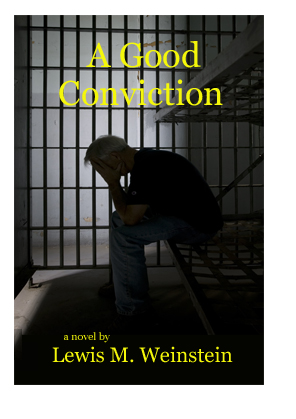
* a review of A GOOD CONVICTION by Jean Poulos (posted on Goodreads Apr 24, 2016) … thank you Jean
Posted by Lew Weinstein on December 4, 2016
***
I found myself not wanting to put the book down.
The theme of the book feels like it was taken right out of today’s headlines. Joshua Blake has graduated university and will be starting law school in the fall. He has come to Manhattan to work in a law firm for the summer. Suddenly Joshua finds himself arrested, convicted and in Sing Sing all for a crime he did not commit nor was he near the area of the crime. We follow “Team Blake” as they try to prove Joshua innocent.
The book is well written and researched.
I began to hate the pompous ADA Claiborne. Weinstein can create a great bad guy. The character development is excellent and the plot development is good. The pace is fast but did slow down a bit in the middle of the book. The ending left me feeling good. The book is 400 pages long. I read this as an e-book from Amazon.
***
AVAILABLE IN PAPER & KINDLE AT AMAZON
Posted in *** Uncategorized | Leave a Comment »
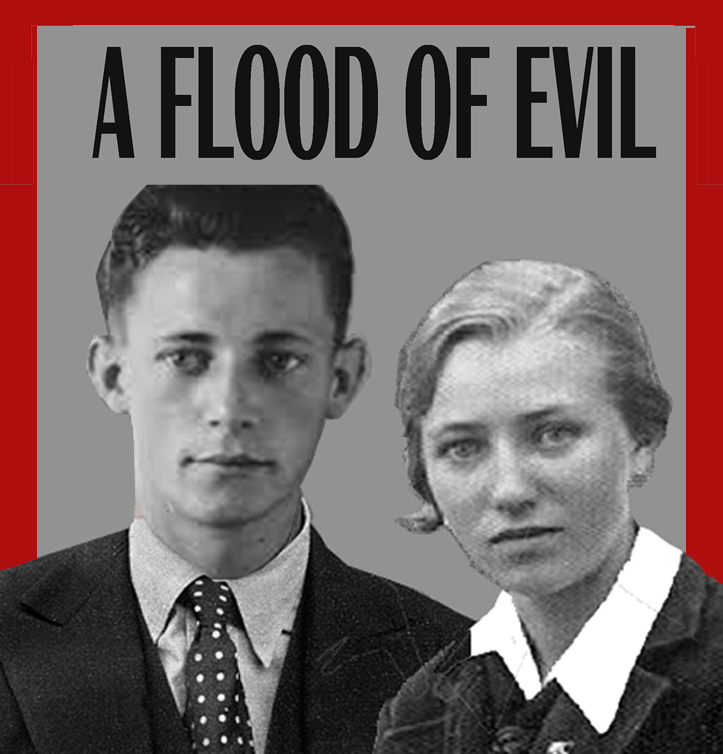
5 ***** reviews of A FLOOD OF EVIL … thank you Marty, Ann Marie, Peggy, Peter, Judie & Ilene
Posted by Lew Weinstein on December 4, 2016
***
5 ***** from Marty Fried … posted Sept 13, 2016
I’ve always been interested in the how and why of the Nazi rise to power. There are plenty of stories about the holocaust, the evils of the Nazis, the torture, etc.
This book, though, is different. It told about how it got started, and what it was like for the people living in the middle of it all during the early days. And that’s what I liked about the story.
It starts out with the trial of a Nazi who is facing death for his part in the atrocities. Just another evil Nazi who deserves to die, it seems. But his death is averted by the testimony of a Jewish woman whose family was all killed by the Nazis, and she herself was forced to prostitute herself to the Germans to survive death. Yet she pleaded for his life, and he was
The book is about why she did this.
It’s a love story about a brave couple who did all they could to try to stop Hitler’s rise to power.
I went back and reread the prologue after finishing the book and found it to be much more meaningful and emotional after knowing the full story. Now, I’m waiting for Book Two, to see what happens during the actual war.
***
5 ***** from Ann Marie (posted Jul 14, 2016)
In A Flood of Evil, Lewis Weinstein has written a novel that is both compelling and riveting.
The love, strength and courage between Anna, the Jewish journalist and Berthold, the German boy which takes place during the rise to power of Adolph Hitler, is a real page turner. The mix of historical facts and realistic characters makes this a must read book. The author skillfully makes you able to believe that history is most certainly able to repeat itself.
Can’t wait for Part 2!! (NOTE: the sequel, as yet untitled, is well underway.)
***
5***** from Peggy Hart (posted Oct 12, 2016)
I learned so much history from this book. Can not wait for book two! For those waiting for book two, if you have not read “The Heretic” it is excellent!!!!
***
5***** from Peter Jowers (posted Jul 11, 2016)
Lloyd summed it up very well. I think it is a very good introduction to what must have existed: opposition to Hitler in his rise to power and during the war possible underground resistance, some of which is well known. I look to Part 2 coming out.
***
5 ***** from Judie (posted Oct 20, 2016)
The title, A FLOOD OF EVIL, refers to what would happen to the world if Adolf Hitler ever achieved power.
In 1946, Nazis were tried in Nuremberg. As the story begins, one young man, Berthold Becker, is the defendant who is eligible for the death sentence because of his Nazi activities. He has admitted his guilt, but before the prosecutor, Abraham Weintraub, completes his presentation, a Jewish woman, Anna Gorska, testifies that Becker should not be put to death. She told the court, “Bertold Becker, although a Nazi, did more than any of the great Allied nations to save Jewish lives. Many lives, not just mine. That is reason enough to spare his life.”
***
5 ***** from Ilene (posted Oct 14, 2016)
Lew Weinstein is a master at Historical Fiction. His description of the lead up to Hitler’s Germany is eerily similar to what we are seeing in this year’s presidential election. People then asked “how could Hitler rise to power”? Well, we’re living it, but I digress. The story is more than just a story of Hitler’s Germany – it is also a story of two unlikely lovers and the readers gets to learn how this relationship blossomed. Can’t wait for Vol. 2!
***
AVAILABLE FROM AMAZON IN PAPER & KINDLE
Posted in *** Uncategorized | Leave a Comment »
a 5***** review of A FLOOD OF EVIL by Lloyd Liggett … posted on Goodreads Jul 7, 2016 … thank you Lloyd
Posted by Lew Weinstein on December 4, 2016

***
This is one of the best books I have ever read!
It is “historical fiction” of the highest order, and a thoroughly engrossing story of the beginning relationship between a young German man and a young Polish-Jewish woman against the backdrop of Hitler’s appearance and rise to power as The Feuhrer.
While it follows his rise, it also, gives us an insight into why he had such appeal to the German People, and his horrific hatred of the Jews; the inability of The Church or of neighboring nations to take a more active approach to recognize, or deal with the growing menace Hitler’s Germany was becoming.
On the fictional side, it shows how this young German man and this young Polish-Jewish woman are drawn into the maelstrom of WW II. At the end of which he is being tried as a German “war criminal” and she is the sole survivor of her family’s ordeal at the Auschwitz “death camp”.
This is Book 1 of Mr Weinstein’s proposed 2 book series. Book 2 will cover from the “start” of The War until the “war trials” afterward. I am, eagerly, awaiting Book 2 to discover “the rest of the story”. (NOTE: the sequel, as yet untitled, is well underway.)
A really wonderful read! My comments can not do justice to it!
***
AVAILABLE ON AMAZON IN PAPER & KINDLE
Posted in *** Uncategorized | Leave a Comment »
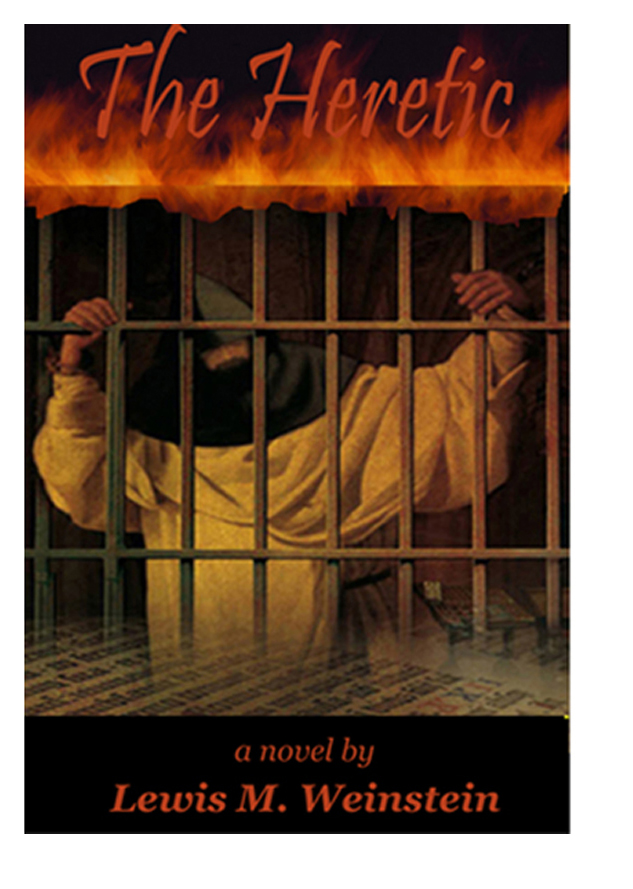
a 4**** review of THE HERETIC by David Lowther … (posted on Goodreads on Apr 19, 2015) … thank you David
Posted by Lew Weinstein on December 4, 2016
I approached The Heretic with a small amount of trepidation because, as a gentile, I wasn’t certain that I would follow the passages of the explanation of the Jewish faith which I knew to be contained in the book.
In the event I needn’t have been concerned at all. Yes there was much of what I expected but all of this was wrapped around a thrilling and superbly told story and added strength to what Lewis Weinstein was trying to achieve; to give readers a complete understanding of how and why the Jews were treated so appallingly in fifteenth century Spain.
The character descriptions are stunning, location is convincingly described and the action sequences exciting. I loved the hero and hated the villain but this is no knight in shining armour story. The inquisitors are seriously evil and misguided and any claim made that they can justify doing what they did in the name of the Catholic church is complete nonsense.
Small wonder that Pole John Paul II apologised, amongst other things, for the murderous Inquisition and the centuries long persecution of the Jewish people. This feels, frankly, grossly inadequate.
Woven into this terrific tale are real life people like Johannes Gutenberg of the printing press fame and Ferdinand II of Aragon and Isabella I of Castile whose marriage led to the unification of Spain in the 16th. century.
I’ve always believed that the hatred of Jews was motivated by them being held responsible for the death of Christ and by envy of their skills and talents which have enriched the history of our planet. That much is confirmed in The Heretic. The holocaust, however, can only be perhaps partly explained by this. Hitler’s detestation of non Aryan racial groups is maybe a stronger motivation for the Nazis. The Fuhrer did, after all, persecute the Christian churches though not, of course, with such vehemence.
The Heretic is a very fine book indeed.
David Lowther
Author of The Blue Pencil and Liberating Belsen
***
AVAILABLE ON AMAZON IN PAPER & KINDLE
Posted in *** Uncategorized | Leave a Comment »
* a 5***** review of THE HERETIC from Lisa … (posted on Goodreads Sept 30, 2016) … thank you Lisa
Posted by Lew Weinstein on December 4, 2016
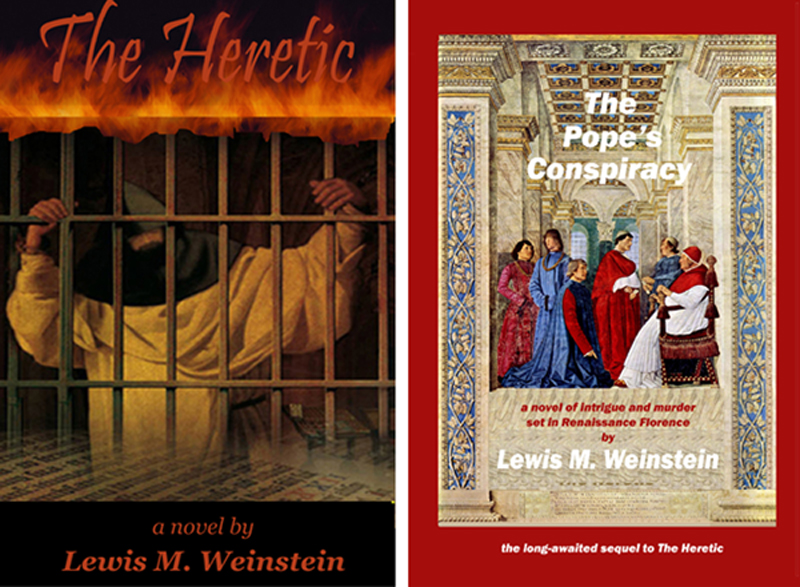
***
This historical novel is well-researched and the story is captivating, although difficult to read in places because of the terrible violence perpetrated against Jews and forcibly baptized Christians (and their descendants) suspected of “reverting” to Judaism in medieval Spain. The author captures well the dangers in the lives of these conversos and, for those who wish to live as Jews, the risks they ran to practice their faith and be true to their heritage.
All of this is in the context of the lives of the Catalan family and their associates, for whom I came to care. How tragic that so many people were persecuted for their beliefs based on false and perverted doctrines, when the value of every human being as a child of God and the importance of agency and freedom of conscience are fundamental to God’s true plan of salvation.
The author waxes didactic in places (as I just did), trying to get the details of the various points of view into the record, but that did not mar the book for me–it was fascinating, if deeply disappointing at times, to learn the positions of those who, as Milton wrote in Areopagitica, use the means of “a false and bloody superstition” to protect what is supposed to be a loving and agency-respecting truth.
The book ended too soon for me–I would have liked to see what happened to later generations of the Catalan family–so this is perhaps a call for a sequel. (NOTE: there is a sequel, titled THE POPE’S CONSPIRACY.) For readers who wish to know more about the position of Jews in medieval Spain and get good mystery stories into the bargain, I also recommend Caroline Roe’s “Isaac of Girona” series.
Congratulations to Lewis Weinstein on a job well done, and some truly impressive support for The Heretic from notable people such as Elie Wiesel and Cardinal O’Connor, among others.
***
AVAILABLE AT AMAZON in PAPER & KINDLE
Posted in *** Uncategorized | Leave a Comment »
* why I have not thanked many of you for your comments on my reviews
Posted by Lew Weinstein on November 19, 2016
I have made it a point to thank all Goodreads readers who have commented on or liked my reviews. But three weeks ago I suffered a massive heart attack and, although I am recovering nicely, I have fallen far behind on my thank-you’s and I don’t believe I will have time to catch up, although I appreciate your comments just as much. Please forgive me. I will try to stay current with new reader responses to my reviews.
Posted in *** Uncategorized | 4 Comments »
* a 5***** review of A FLOOD OF EVIL … thank you Amy Ferguson
Posted by Lew Weinstein on October 2, 2016
By A. Ferguson …
Very few writers can successfully write historical fiction as compellingly as Lewis M. Weinstein. I first discovered his talent when I read his 2000 novel, THE HERETIC. Through his ability to imagine the past as it might have been allows present day readers to delve into history with such a interest that they begin to see how the past draws our attention while demanding us to understand.
A couple of years ago, I was kindly given the opportunity by Lewis to be an early reader of his latest work, A FLOOD OF EVIL. As in the past when reading Lewis’ work, I became lost in the story. In this first book of a two book series, we follow the story of a German Catholic boy by the name of Berthold Becker and a Polish Jewish girl by the name of Anna Gorska as they find themselves in the midst of a world ruled by bigotry, fear, and hatred. This is Hitler’s world, a world that forces Berthold and Anna to unimaginable levels of fear and, in turn, courage.
With his latest novel, Mr. Weinstein is at his best when he challenges readers to look into the face of evil; to look into the depths of abject degradation — for in this he is fearless. It is not lost on me, as I hope it won’t be lost on present day readers that the rhetoric of hate and fear that was stirred up by Hitler could just as easily be seen in some of the rhetoric of one of the politicians running for President today.
It would be too easy for us to look away or to minimize the talk of would-be leaders when they speak to our fears in an attempt to organize a systematic hatred of any one group of people. To downplay as the world did during the years that led up to WWII would be foolish and disrespectful to our collective past. Indeed, when Hitler first arrived on the stage of politics, were there not people who minimized as well? By the time the world took note of the danger of having allowed a man of such vitriolic hatred such a platform, it was too late. Here is where Lewis’ novel takes root.
A FLOOD OF EVIL is a cautionary tale that warns against such ignorance and hate. Yes, it was indeed left to the real life versions of characters like Berthold and Anna to risk their own safety and security because they could not accept a world where evil men like Hitler were given a stage to perform and from which to rule.
It truly is unfathomable to understand what the Jews of Europe were made to endure at the hands of the Nazis, but in Lewis Weinstein’s capable hands, it is possible to imagine. And, in today’s world, where we might be closer than we’d care to admit to being in a position where such hatred and power might be in line to become reality, A FLOOD OF EVIL is made that much more compelling and timely.
***
A FLOOD OF EVIL
is available in paper and kindle formats at …
as are all of Lew Weinstein’s books
Posted in *** Uncategorized | Leave a Comment »
* All of Lew’s books are available at amazon …
Posted by Lew Weinstein on September 25, 2016
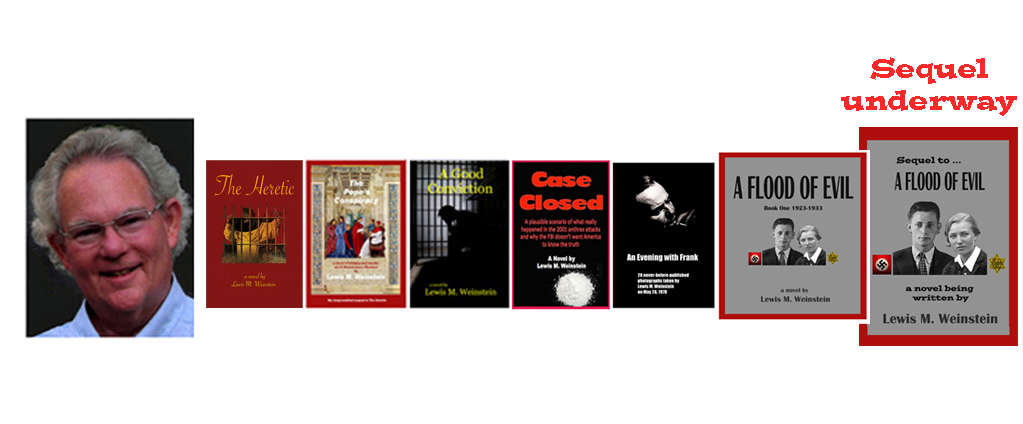
All of Lew’s books are available at amazon …
Posted in *** Uncategorized | Leave a Comment »
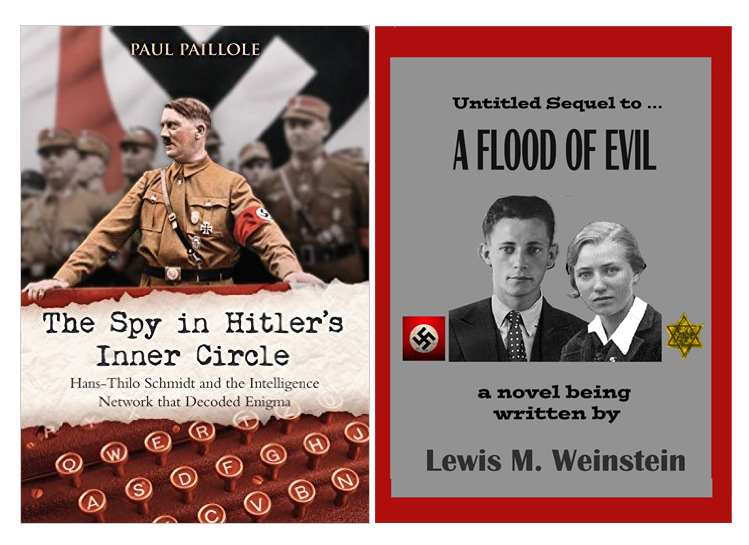
* research for the sequel to A FLOOD OF EVIL … The Spy in Hitler’s Inner Circle
Posted by Lew Weinstein on September 12, 2016
***
This is an incredible story, scarcely believable, of how a well-placed German came to French Intelligence and offered to supply the most important Nazi secrets, and did so repeatedly over a substantial period of time.
What better resource could I look for as I write the sequel to A FLOOD OF EVIL, in which Berthold and Anna desperately strive to alert the western democracies to the dangers posed by Hitler.
I’m not finished my read, but here are a few examples …
… stunningly precise and varied intelligence was gathered by H.E. between 1932 and 1940 on the Nazi party, the rearmament of Germany, the organization of its military, administration and police, and on the activities of the Wehrmacht High Command and the Abwehr
… H.E., familiar with illegal border crossings, had taken stock of the risks. At forty-six, well positioned in the Nazi hierarchy, holding a superior civil post, now frequenting— thanks to the fame of his parents and his brother— the upper milieus of the Berlin military and civil societies … his privileged position in the party, the rise of his brother in the military high command, his extensive responsibilities in the Forschungsamt— all offered daily opportunities.
… From February 1934, H.E.’ s invisible ink letters provided a weekly report about the increasing motorization and mechanization of the German army
Posted in *** Uncategorized | Leave a Comment »
* another Goodreads 5***** review … thank you Ann Marie
Posted by Lew Weinstein on September 11, 2016
Lewis Weinstein has written a novel that is both compelling and riveting. The love, strength and courage between Anna, the Jewish journalist and Berthold, the German boy which takes place during the rise to power of Adolf Hitler, is a real page turner. The mix of historical facts and realistic characters makes this a must read book. The author skillfully makes you able to believe that history is most certainly able to repeat itself.
Can’t wait for Part 2!!
***
NOTE from LEW:
I am making good progress with a draft of what I think will be Book 2 in a trilogy.
Posted in *** Uncategorized | Leave a Comment »
* a new Goodreads 5***** review of A FLOOD OF EVIL … thank you Lloyd
Posted by Lew Weinstein on August 19, 2016

***
Lloyd Liggett gave A FLOOD OF EVIL 5***** …
This is one of the best books I have ever read! … “historical fiction” of the highest order … a thoroughly engrossing story of the relationship between a young German man and a young Polish-Jewish woman against the backdrop of Hitler’s appearance and rise to power .
It also gives us an insight into why Hitler had such appeal to the German People … his horrific hatred of the Jews … the inability of The Church or of neighboring nations to take a more active approach to recognize, or deal with the growing menace Hitler’s Germany was becoming.
This is Book 1 of Mr Weinstein’s proposed 2 book series. I am eagerly awaiting Book 2.
A really wonderful read! … My comments can not do justice to it!
.
***
A FLOOD OF EVIL (and all of Lew’s novels)
is available on amazon in both print and kindle format
(also available in NOOK format at B&N) …
https://www.amazon.com/Flood-Evil-Book-1-ebook/dp/B01GQUC9KQ/ref=sr_1_1?s=books&ie=UTF8&qid=1471595978&sr=1-1&keywords=a+flood+of+evil
Posted in *** Uncategorized | Leave a Comment »
* a new reader comment regarding the ending of A FLOOD OF EVIL … “the conclusion of your novel is just downright touching” … thank you Randy
Posted by Lew Weinstein on August 19, 2016
Randy Becker writes …
” … the conclusion of your novel is just downright touching. In the midst of all that intrigue and horror, we are reminded that love trumps hate. Well done sir — very human.”
.
***
A FLOOD OF EVIL (and all of Lew’s novels)
is available on amazon in both print and kindle format
(also available in NOOK format at B&N) …
https://www.amazon.com/Flood-Evil-Book-1-ebook/dp/B01GQUC9KQ/ref=sr_1_1?s=books&ie=UTF8&qid=1471595978&sr=1-1&keywords=a+flood+of+evil
Posted in *** Uncategorized | Leave a Comment »
* What I find scary is how some of the Nazi talk in A FLOOD OF EVIL resembles Donald Trump’s words.
Posted by Lew Weinstein on August 12, 2016
from a reader who read an earlier draft …
I have been meaning to tell you I finished A FLOOD OF EVIL. I loved how you tightened up the narrative.
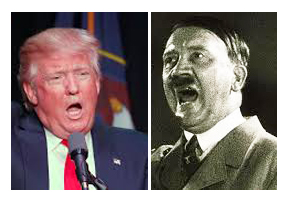
“What I find scary is how some of the Nazi talk resembles Donald Trump’s words. You wrote your book and did your research long before Trump came on the scene. The similarities are astonishing. And he does appeal to the same type of people. Horrifying.”
Posted in *** Uncategorized | Leave a Comment »
* a new review of A FLOOD OF EVIL … to be published in the Beth-El synagogue newsletter in September
Posted by Lew Weinstein on August 2, 2016
by Amy Kaplan …
Several outstanding new novels are set against the background of the Second World War.
A Flood of Evil, Book One 1923-1933 by Beth El’s own Lewis M. Weinstein is the first of two novels Weinstein is writing about a German Catholic boy and a Polish Jewish girl.
Berthold is favored by Nazi party officials, yet is opposed to what the Nazis are doing. Anna wants a more modern life, and wishes to be the first girl from her village to attend the University of Warsaw. How these two meet and fall in love is one aspect of the story.
The real interest, for me, is in the details of daily life in the pre-War era and the close-ups Weinstein gives of the highest-ranking Nazis as they ascend to power.
The story is framed by a present-day narrative about the daughter of the man who ultimately prosecuted Berthold at Nuremberg; this young woman’s quest for more information leads her to interview the aged Berthold in Munich and Anna in Jerusalem.
This is an entertaining read that also educates the reader about a key period in history.
Posted in *** Uncategorized | Leave a Comment »
* mystery writer Rick Ollerman praises A FLOOD OF EVIL … “so real you’ll forget it’s fiction”
Posted by Lew Weinstein on August 1, 2016

“Weinstein’s FLOOD OF EVIL takes a horrifying period of history and turns it into a page-turning novel. The characters are so well-drawn and the cast so real you’ll forget it’s fiction. Can’t wait for volume two….”
***
A FLOOD OF EVIL IS AVAILABLE ON AMAZON
IN PRINT OR KINDLE FORMAT …
***
SO IS RICK OLLERMAN’s LATEST THRILLER …

https://www.amazon.com/Truth-Always-Kills-Rick-Ollerman/dp/1933586826/ref=asap_bc?ie=UTF8
Posted in *** Uncategorized | Leave a Comment »
* acclaimed author Faye Kellerman praises A FLOOD OF EVIL … a riveting story
Posted by Lew Weinstein on July 30, 2016
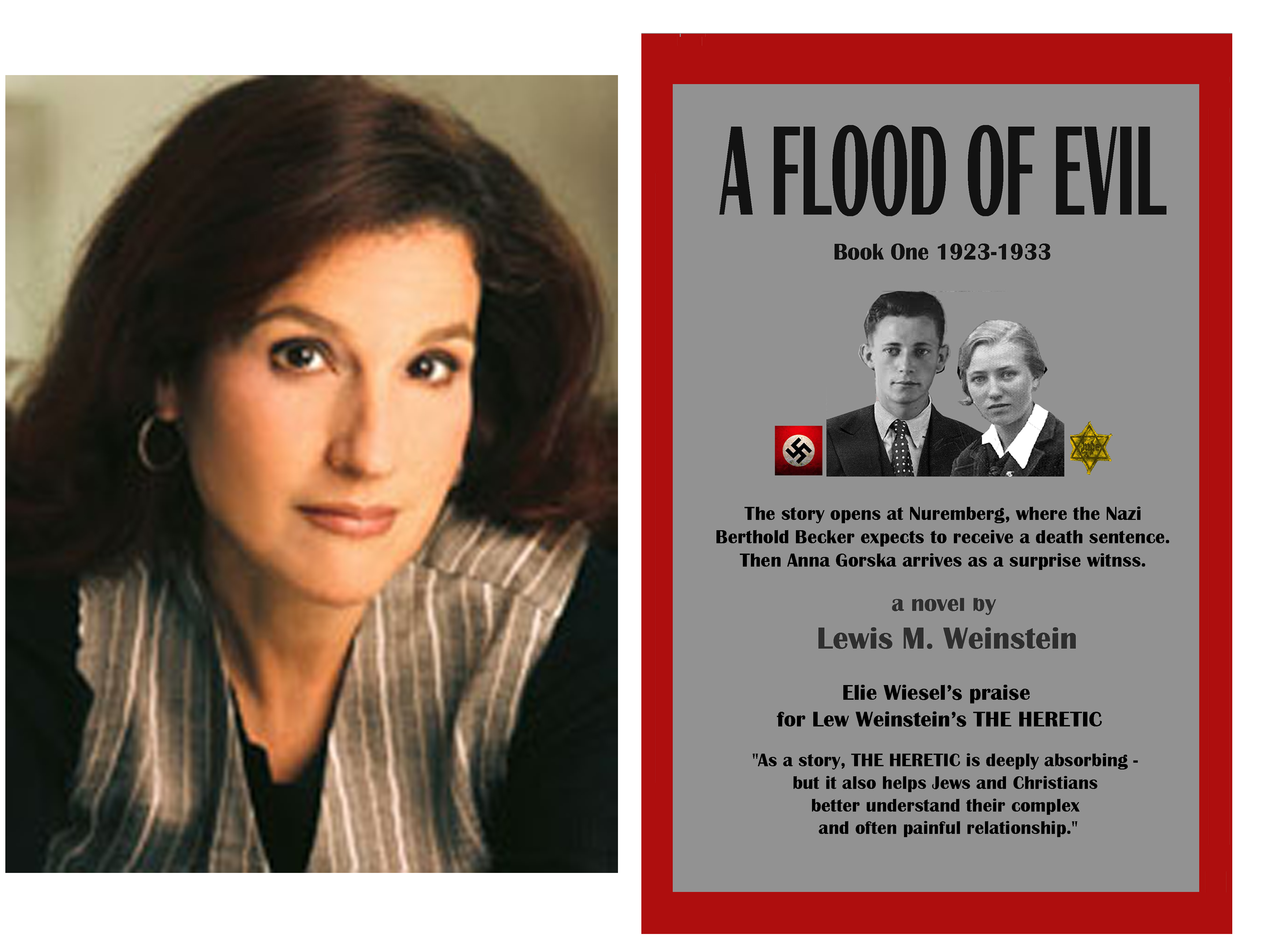
Faye Kellerman … “Author Lew Weinstein has written a riveting story set in a dark chapter of history filled with timeless truths and timeless love.”
***
A FLOOD OF EVIL IS AVAILABLE ON AMAZON
IN PRINT OR KINDLE FORMAT …
***
SO IS FAYE KELLERMAN’s LATEST MYSTERY THRILLER …
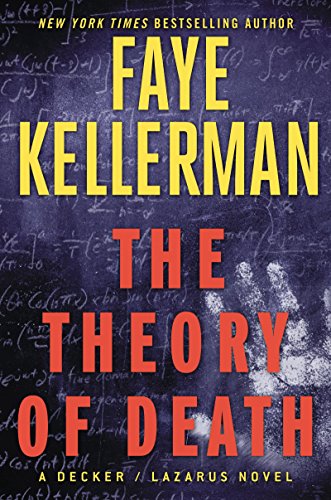
https://www.amazon.com/Truth-Always-Kills-Rick-Ollerman/dp/1933586826/ref=asap_bc?ie=UTF8
Posted in *** Uncategorized | Leave a Comment »
* Donald Trump continues to follow the path of Adolf Hitler
Posted by Lew Weinstein on July 28, 2016
Every day another one of Hitler’s vile campaign approaches shows up in the Trump campaign.
Yesterday it was the SUPPRESSION OF A FREE PRESS as Trump’s muscle banned a Washington Post reporter from one of Trump’s recent events.
Jose DelReal is one of a small team of people who cover Donald Trump’s presidential campaign for The Washington Post. On Wednesday, he was in Milwaukee to cover an appearance by Trump running mate Mike Pence. DelReal was barred from covering the event as a reporter, in keeping with Trump’s six-week-old ban on The Washington Post. DelReal then tried to enter the event as a citizen. He was told he could not enter with a cell phone despite the fact that other people were not held to that same standard. He put his phone and computer in the car and again tried to enter. He was refused — again — and patted down. “I don’t want you here. You have to go,” the security official told him.
Today TRUMP EQUATED KILLING JOURNALISTS WITH RUNNING A COUNTRY
“He’s running his country and at least he’s a leader, unlike what we have in this country,” Trump said when asked by “Morning Joe” Republican host Joe Scarborough about Putin’s alleged killing of journalists and political opponents.
If you think I’m overstating the similarities between Trump and Hitler, I invite you to read my new historical novel A FLOOD OF EVIL …
A FLOOD OF EVIL highlights Hitler’s approach, which offered no details regarding solutions and repeated incessantly that only a strong Fuhrer could solve what was wrong with Germany. Right wing German conservatives were among those who brought Hitler to power. They thought they could control him, but it took Hitler only a few days in office to prove them wrong.
Hitler’s rise to power is told through the eyes of two young lovers, a German Catholic boy named Berthold Becker and a Polish Jewish girl named Anna Gorska, who struggle to convince those in power to stop Hitler before he becomes Chancellor.
Early readers of A FLOOD OF EVIL have urged American voters to read this story in order not to repeat in 2016 the mistakes made in Germany in 1933.
***
Available in print and kindle formats on amazon …
Posted in *** Uncategorized | Leave a Comment »
* several readers have told me that A FLOOD OF EVIL has given them important insights into Donald Trump’s campaign of anger and hate.
Posted by Lew Weinstein on July 23, 2016
Hitler’s core strategy was to use fear and hate to attract angry, uneducated voters while providing no details of what he would actually do to correct Germany’s problems.
Sound familiar?
Many people in Germany in the early 1930s understood what Hitler was saying. Many of them however, including leading conservative politicians, businessmen and the military, believed Hitler could be easily controlled once in power, and that they could use him to accomplish their own aims. It took but a few days to prove them horribly wrong, and their mistake proved to be irreversible.
In my opinion, many Republicans currently supporting Trump suffer from the same delusion.
If you are frightened by the possibility of a Trump Presidency, I encourage you to read A FLOOD OF EVIL, and then work hard to keep Trump out of the Oval Office.

***
A FLOOD OF EVIL is available in print and ebook formats at amazon.com …
https://www.amazon.com/Flood-Evil-Book-1/dp/1494295784/ref=sr_1_1?ie=UTF8&qid=1469286223&sr=8-1&keywords=a+flood+of+evil
Posted in *** Uncategorized | Leave a Comment »
A FLOOD OF EVIL … a fascinating story … poignant … compelling … difficult to put down … a message for America in 2016
Posted by Lew Weinstein on July 15, 2016
a new review of A FLOOD OF EVIL … 5.0 out of 5 stars … A Most Important History Lesson … By Brenda Schiff on July 14, 2016
“A Flood of Evil” by Lewis Weinstein is a compelling read. It offers a thoroughly researched history of Nazi Germany in the years 1923-1933, describing Hitler’s rise to power. However, because it is set within such a fascinating story, it is difficult to put down.
“Weinstein’s creative and disciplined mind has enabled him to deliver a most important history lesson, that is now especially poignant, considering the politics of the day…..This book should be on every high school reading list!”
Lew Weinstein adds …
My novel shows how Adolf Hitler seized power in Germany in 1933, in the face of statements by political leadership that they could control him, that he would never be able to implement the policies he had so clearly articulated. They were wrong and it took only two days in power for Hitler to make that clear.
Would you put faith in the pathetically weak Republican leadership to be able to control Trump? I believe a vote for Trump would be the most foolish and dangerous act any American could take.
Posted in *** Uncategorized | Leave a Comment »
* from a reader: Anna and Berthold are great characters
Posted by Lew Weinstein on June 16, 2016
A reader’s reaction to A FLOOD OF EVIL
“I just finished your thoughtful book, and I enjoyed it very much. Your research is outstanding and the words flow, allowing the story to easily slip into the readers’ mind. Great characters, Anna and Berthold, developed so you care about them and understand their dangerous and scary positions. And for young people who don’t know of the horror of the Nazis, an important history lesson, one that is relevant in today’s political world.” … Bill Lorraine
***
Posted in *** Uncategorized | Leave a Comment »
* excerpts from the Prologue of A FLOOD OF EVIL
Posted by Lew Weinstein on June 14, 2016

The story of Berthold Becker, a German Catholic, and Anna Gorska, a Polish Jew, is also the story of Adolf Hitler’s rise to power in the years from 1923 to 1933. It is a story of particular importance for all of us in America to understand in 2016. Here are EXCERPTS from the Prologue of A FLOOD OF EVIL …
BERTHOLD BECKER IS ON TRIAL AT THE 1945 NUREMBERG WAR CRIMES TRIAL …
… Berthold Becker showed little emotion as his jailer unlocked his cell and escorted him along the dark corridor lined with soldiers. For several weeks he had sat quietly and watched as the trials of the other high-ranking Nazis had proceeded, and for the past two days he had paid somewhat greater attention as the evidence against him was presented, and what he regarded as a pathetic defense followed. It wasn’t his attorney’s fault. He was guilty. He had done horrible things. He couldn’t change what he had done and now he would pay the price. He expected to be hung.
ANNA GORSKA TESTIFIES AT BERTHOLD’S TRIAL …
… “Berthold Becker was a member of the Nazi Party, and in that capacity, he participated in the commission of at least some of the crimes he has been charged with by this Tribunal. I am sure he expects to be punished.” She paused. “But for reasons I will explain, he should not be put to death.
… “This defendant is not now and never was an evil man. He was dragged into a maelstrom not of his choosing and from which he was unable to escape. It is easy to say he should have done more to stop the Nazis and in hindsight perhaps he would agree.
… “Berthold Becker had a unique vantage point during the entire Nazi terror. He knows and will tell a truth that others deny.” Looking back to the justices, speaking slowly, she delivered each of her final words as if it were a dagger. “You have the power to allow the terrible story of German evil and guilt to be known. Do not take the life of this defendant. Let Berthold Becker live to tell his story.”
***
Available at amazon in print & kindle formats
from an amazon review ….
“I was caught up in the book from the very beginning. It’s a powerful and complex story about love, fear and the corrosive abuse of political power. I would say a lesson we need to recall today. Enjoy it. I did.”
Posted in *** Uncategorized | Leave a Comment »
* amazon offers temporary discount on paperback edition of A FLOOD OF EVIL … price is now $14.01
Posted by Lew Weinstein on June 14, 2016
Amazon – on its own initiative – has decided to provide a temporary discount price of $14.01 for the paperback edition of A FLOOD OF EVIL. They will not tell me how long this discount will last, but it is definitely not permanent, so if you’re planning to purchase a paperback copy, this would be a good time to do it.
Thank you, amazon!
Posted in *** Uncategorized | Leave a Comment »
* Thank you … exciting initial sales in both paper and ebook formats
Posted by Lew Weinstein on June 13, 2016
***
I want to thank my Facebook and Goodreads friends for your initial response to the publication of my new novel A FLOOD OF EVIL. Many of my Goodreads friends have also marked it “to read.” Now I hope those who read my book on kindle or in paper will enjoy it and write reviews. Thanking you in advance.
Here is the first amazon review …
“I was caught up in the book from the very beginning. It’s a powerful and complex story about love, fear and the corrosive abuse of political power. I would say a lesson we need to recall today. Enjoy it. I did.”
About A FLOOD OF EVIL …
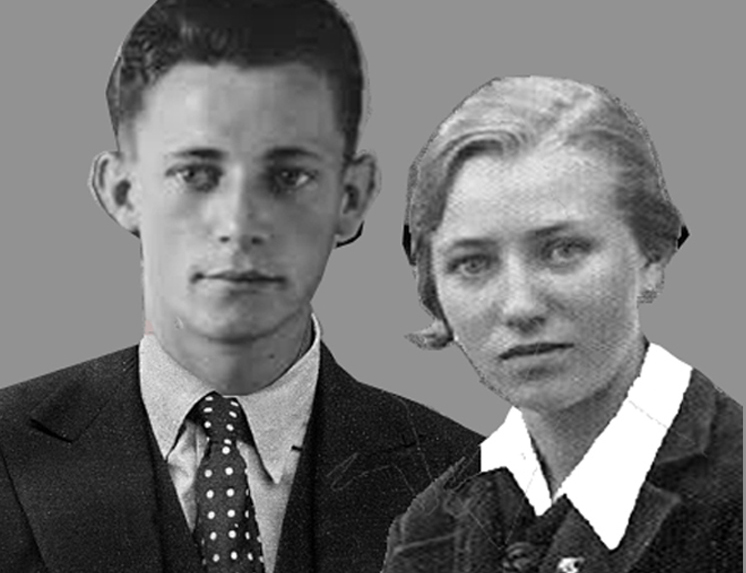
A German Catholic boy and a Polish Jewish girl join forces to oppose Adolf Hitler as he makes his move to power.
The story opens in Nuremberg, where Berthold Becker is on trial with other major Nazi war criminals. He expects a death sentence, but Anna Gorska arrives and testifies on his behalf. Berthold is sentenced to 20 years in prison.
Forty-five years later, the daughter of Becker’s Nuremberg prosecutor asks her father to collaborate with her in a book about the characters in his Nuremberg trial. That book becomes the frame within which the story of Berthold and Anna is told. Book One covers the years from 1923 to 1933, from Hitler’s Beer Hall Putsch to his appointment as Chancellor.
Posted in *** Uncategorized | Leave a Comment »
* A FLOOD OF EVIL is now also available on NOOK
Posted by Lew Weinstein on June 11, 2016
Posted in *** Uncategorized | Leave a Comment »
* Why did it take you 6 years to write A FLOOD OF EVIL?
Posted by Lew Weinstein on June 9, 2016
Several people have asked me why it took 6 years to research and write A FLOOD OF EVIL. Well, this is a historical novel, and I think it’s my obligation as an author to get the history correct.
There are no scenes in my novel which simply tell the history, but often a few words worked into the ongoing story of my characters can set the scene in a way that makes it more real to the reader.
How much research? Here is the SELECTED BIBLIOGRAPHY which is included at the end of A FLOOD OF EVIL. At least one research note from every one of these books informed at least one scene in my novel …
.
Abel, Theodore … Why Hitler Came into Power
Allen, William Sheridan … Nazi Seizure of Power
Baird, Jay … To Die for Germany: Heroes in the Nazi Pantheon
Bennett, Edward W … German Rearmament
Bitter, Alexander … Kurt Von Schleicher
Blobaum, Robert … Antisemitism In Modern Poland
Broszat, Martin … Hitler and the Collapse of Weimar Germany
Burleigh, Michael … The Third Reich: A New History
Conradi, Peter … Hitler’s Piano Player: Ernst Hanfstaengl
Coppa, Frank J. … The Papacy, the Jews, and the Holocaust
Cornwell, John … Hitler’s Pope: The Secret History of Pius XII
Davies, Norman … The Past in Poland’s Present
Dederichs, Mario R. … Heydrich: The Face of Evil
Domarus, Max … Hitler – Speeches and Proclamations
Dornberg, John … Munich 1923
Dorpalen, Andreas … Hindenburg and the Weimar Republic
Eliach , Yaffa … The Shtetl of Eishyshok
Evans, Richard … The Coming of the Third Reich
Ferguson, Adam … When Money Dies
Fest, Joachim … Hitler
Fest, Joachim … The Face Of The Third Reich
Fischer, Klaus … The History of an Obsession
Godman, Peter … Hitler and the Vatican
Goebbels, Josef … My Part in Germany’s Fight
Gold, Ben-Zion … Jews in Poland before the Holocaust
Gordon, Harold J. … Hitler and the Beer Hall Putsch
Gutman, Yisrael … The Jews of Poland Between the Wars
Haffner, Sebastian … Defying Hitler
Hanfstaengl, Ernst … Hitler
Hanser, Richard … Putsch!
Harsch, Donna … German Social Democracy and Nazism
Hastings, Derek … Catholicism and the Roots of Nazism
Heller, Celia Stopnicka … Jews of Poland Between the Wars
Herzl, Theodor … The Jewish State
Heschel, Abraham Joshua … The Inner World of the Jew
Hetherington, Peter … Unvanquished: Joseph Pilsudski
Hitler, Adolf … Mein Kampf
Hoffman, Eva … Shtetl: The History of a Small Town
Jedrzejewicz, Waclaw … Pilsudski: A Life for Poland
Junger, Ernst … Storm of Steel
Kershaw, Ian … Hitler: 1889-1936 Hubris
Krieg, Robert … The Vatican Concordat With Hitler’s Reich
Lewy, Guenter … The Catholic Church And Nazi Germany
Manvell, Roger … Doctor Goebbels
Mendelsohn, Ezra … The Jews of East Central Europe
Mendelsohn, Ezra … Zionism in Poland
Michlic, Joanna Beata … Poland’s Threatening Other
Mierzejewski, Alfred C. … The German National Railway
Modras, Ronald E. … The Catholic Church & Antisemitism
Mommsen, Hans … The Rise and Fall of Weimar Democracy
Morris, Douglas G. … Justice Imperiled: Max Hirschberg
Mosse, George L. … Germans and Jews
Nagorski, Andrew … Hitlerland: American Eyewitnesses
Niewyk, Donald L. … Social Democracy & Anti-Semitism
Nowicki, Ron … Warsaw: The Cabaret Years
Patch, William L. … Heinrich Bruning the Weimar Republic
Pease, Neal … The Catholic Church and Independent Poland
Peterson, Edward Norman … Hjalmar Schacht
Plach, Eva … Cultural Politics in Pilsudski’s Poland
Polonsky, Antony …. From Shtetl To Socialism
Polonsky, Antony … Jews in Independent Poland, 1918-1939
Remarque, Erich Maria … All Quiet on the Western Front
Remarque, Erich Maria … The Road Back
Reuth, Ralf … Goebbels
Richarz, Monika … Jewish Life in Germany
Roth, Joseph … The Wandering Jews
Ryback, Timothy W. … Hitler’s First Victims
Schacht, Hjalmar … My first seventy-six years
Schatz, Jaff … The Jewish Communists of Poland
Scholder, Klaus … The Churches and the Third Reich
Sciolino, Anthony … Christian Anti-Judaism & Nazi Anti-Semitism
Segel, Binjamin … A History of the Protocols of the Elders of Zion
Sinclair, Upton … Dragon’s Teeth
Singer, Isaac Bashevis … The Manor
Smaldone, William … Rudolf Hilferding
Stachura, Peter D … Gregor Strasser and the Rise of Nazism
Stachura, Peter D … Poland Between the Wars, 1918-1939
Stehlin, Stewart A. … Weimar and the Vatican, 1919-1933
Time Life … Fists of Steel
Toland, John … Adolf Hitler: The Definitive Biography
Turner, Henry … Hitler’s Thirty Days To Power
Ventresca, Robert … The Life of Pope Pius XII
Wasserstein, Bernard … On the Eve: The Jews of Europe
Watt, Richard … Bitter Glory: Poland and Its Fate
Weitz, Eric D. … Weimar Germany
Whaley, Barton … Covert German Rearmament
Wolf, Hubert … Pope and Devil: The Vatican’s Archives
Yasni, A. Wolf…. Ciechanow Jewish Community
Zamoyski, Adam … The Polish Way: Poles and Their Culture
Zbrowski, Mark … Life is With People : The Culture of the Shtetl
Posted in *** Uncategorized | Leave a Comment »
* A FLOOD OF EVIL is now available on amazon in paperback as well as ebook format
Posted by Lew Weinstein on June 9, 2016
A FLOOD OF EVIL is now available on amazon in PAPERBACK as well as EBOOK form.
ABOUT PRICING …
I have priced both the paperback and ebook versions below the current market. This is my way of saying thank you to all my GOODREADS and FACEBOOK friends who have been so encouraging to me as I have gone through the 6 year process of researching and writing this book. These introductory prices will be maintained for a short time, after which the prices will be raised.
ABOUT A FLOOD OF EVIL …
A FLOOD OF EVIL is a powerful story of two young people who are thrown by circumstances into a dangerous effort to try to stop Adolf Hitler’s rise to power. The way they carry out that effort, while also dealing with all the issues of their emerging love, makes for a tense and emotional story. At least that was my intent. When you read A FLOOD OF EVIL, you can make your own conclusion as to whether I succeeded.
Thank you again for your support.
Posted in *** Uncategorized | Leave a Comment »
* Lew’s new novel – A FLOOD OF EVIL – has been published!
Posted by Lew Weinstein on June 8, 2016
***
A FLOOD OF EVIL has been published.
The ebook is now available on amazon and a paperback edition will be available in a few days.
A FLOOD OF EVIL introduces a German Catholic boy and a Polish Jewish girl who fall in love and join forces to oppose Adolf Hitler’s rise to power. They are young, vital, and more than a little frightened.
The book opens in a Nuremberg courtroom, where Berthold Becker is on trial with other major Nazi war criminals. His life is saved when Anna Gorska unexpectedly arrives and testifies on his behalf.
Forty-five years later, the daughter of Becker’s Nuremberg prosecutor asks her father to collaborate with her to tell the story of the people in his trial.
“We’ve read her testimony,” the prosecutor says.
“There must be more,” his daughter responds. “If they’re still alive, I want to find them and tell that story.”
Book One of A FLOOD OF EVIL covers the lives of Berthold and Anna from 1923 to 1933, from Hitler’s Beer Hall Putsch to his appointment as German Chancellor. Research and writing of Book Two is ongoing.
Posted in *** Uncategorized | Leave a Comment »
* Lew’s comments on “The Nazi Conscience” by Claudia Koonz
Posted by Lew Weinstein on June 7, 2016

Claudia Koonz sets out to answer the question of why Germans were so willing to participate or at least stand aside for the murder of millions of innocent citizens. She puts forward the proposition that Christian Germans were prepared by the Nazis through a carefully executed program that included relentless denigration of Jews as subhuman enemies of the German “Volk,” coordinated with powerful enforcement against any who strayed from the Nazi line. Altogether she makes a sickeningly convincing case against both the Nazis and the Christian Germans, opposite sides of the same repulsive coin.
Koonz’ case is made even more powerful by the academic tone she almost always maintains. Surely there is anger simmering behind her words, but she rarely lets it filter through.
SELECTED EXCERPTS …
… The popular risers of anti-Semitism the planners of genocide followed a coherent set of severe ethical maximums derived from broad philosophical concepts … they denied the existence of universal moral values and instead promoted moral maxims which they saw as appropriate to their Aryan community … Asserting the superiority of their own communitarian values above all others
… Having fully absorbed knowledge of the “Jewish menace” … a Nazi was ready to accept deportation and murder as just … if he had a Jewish friend, he would say “what a misfortune that my friend is Jewish” rather than “how terrible it is at we are murdering Jews”
… The expulsion of Jews from Germans’ universe of moral obligations was carefully engineered
… The Nazi program sought to break ties between Jews and their surroundings … until Jews were totally isolated from the Christian German population
… The Nazis implemented an acceptance of “ethnic fundamentalism” which summoned its followers to seek vengeance for past wrongs and to forge a glorious future cleansed of ethnic aliens … Germans were enticed to participate in a moral universe accessible only to the favored
… Jews, who before 1933 were friends, neighbors, and colleagues … were now to be considered pariahs, a plague on Germany
… Hitler linked “Jewish” with despised values, such as urbanism, materialism, and greed … link the Jewish press with promoting decadence … blame moral degeneration on sexual intercourse between Jews and Christians
… Most Germans tacitly approved of persecution so long as they did not feel personally threatened or inconvenienced
… Heydrich: too many German citizens perceive Jews as harmless … they must be defined as a threat, loathsome as well as lethal
… Der Sturmer and Das Schwarze Korps both portrayed Jews as not only dangerous but also subhuman … words like “extinction” and “annihilation” he came routine … the intent was to create a German conscience that minimize the psychic stress they might experience when murdering Jews
… The final solution did not develop as evil incarnate but rather as the dark side of ethnic righteousness … to German Christians caught up what they perceived as a high moral purpose purification of racial aliens became a difficult but necessary duty
Posted in *** Uncategorized | Leave a Comment »
* Lew’s comments on “Victims & Neighbors” by Frances Henry
Posted by Lew Weinstein on June 1, 2016
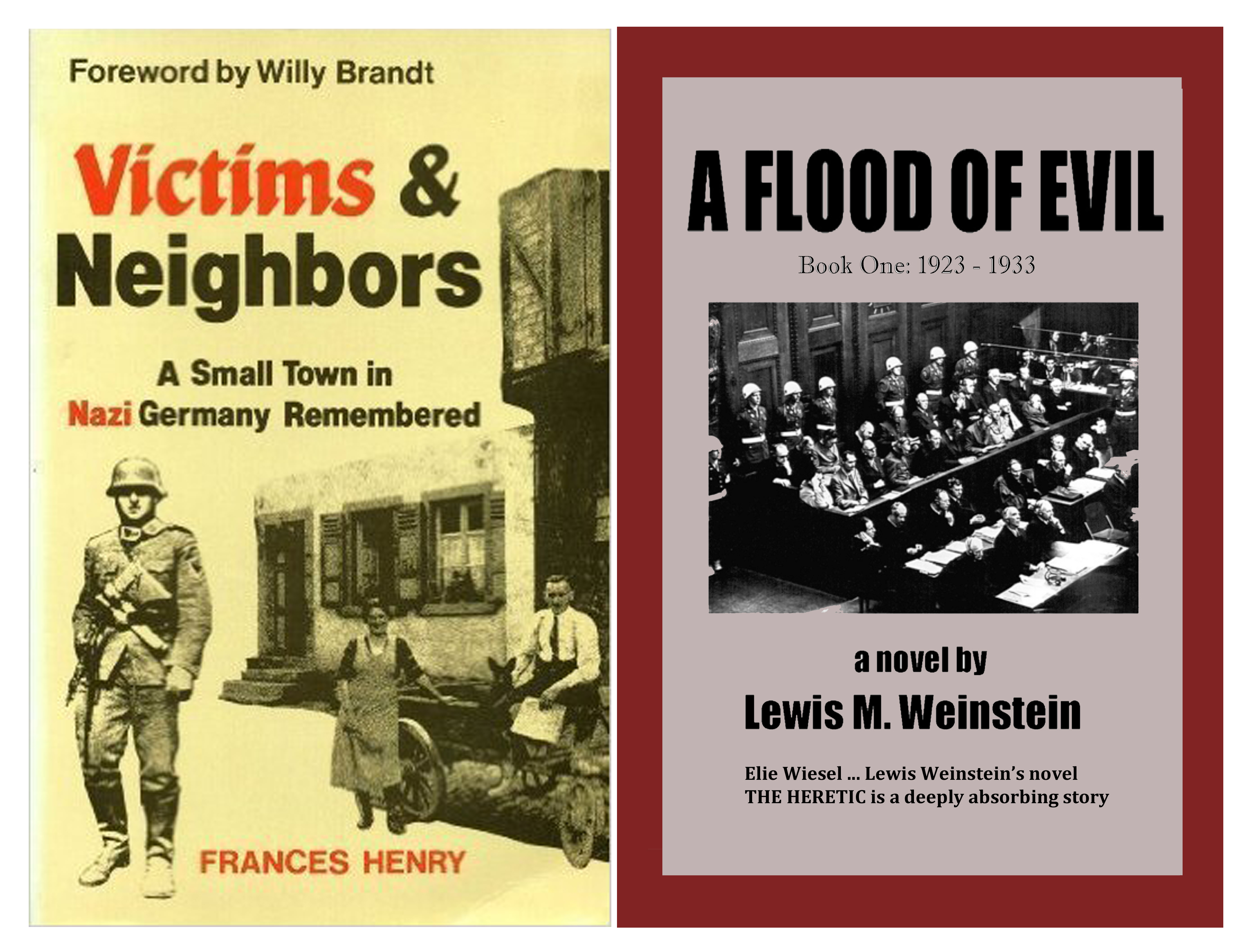
This is an extraordinary book. The author, grand-daughter of Jews who escaped from a small German town, went back to that town, met with people who had known her grand-parents, and produced a thoughtful presentation of the feelings and pressures on both Jews and Christians as the Nazi regime increased its persecution of Jews.
Lifelong friendships were instantly terminated within days of Hitler’s appointment as Chancellor, even before the most oppressive laws and measures were implemented. Most Christians looked away as Jews endured an increasingly lonely and fearful existence. Some Christians exhibited kindness, for instance bringing food to Jews no longer allowed in Christian shops, but most, fearful of being denounced by their neighbors, simply ignored the Jews.
Ms. Henry also recorded attitudes of Christian Germans after Germany’s defeat. Mostly, they were angry at Allied bombing and other so-called “atrocities.” They acted like victims, of the Allies and of Hitler. Nobody felt their own actions were to blame.
What would I have done in their shoes? Could they have done anything meaningful? These are questions I am addressing as I write my novel A FLOOD OF EVIL, Volume One of which will soon be published.
Posted in *** Uncategorized | Leave a Comment »
* Lew’s comments and excerpts from “Jewish Responses to Persecution”
Posted by Lew Weinstein on May 28, 2016

A historical novel, such as A FLOOD OF EVIL, must add the feelings, hopes, despairs, and occasional excitement of the characters to the historical world in which they live. Memoirs are one of the best sources and starting places for emotions which will be incorporated into the story.
JEWISH RESPONSES TO PERSECUTION is a collection of original source documents, with notes, expressing the views of Jews trying to survive the Nazi persecution from 1933 to 1938. Page after page is heartbreaking, depressing,infuriating …
SELECTED EXCERPTS …
… a growing feeling of powerlessness left many feeling isolated … unable even to comprehend the bewildering complexities and seeming inconsistencies of the Nazis’ actions
… What good does it do for her to work hard at school; she can’t achieve anything, can’t become anything; all paths are hopelessly closed for her
… As Jewish leaders tried to develop a strategy … individual Jews had difficulty asseessing what was happening and what was likely … individual experiences, plus stories told by relatives and friends, and even by the press, rarely added up to a consistent picture … sometimes brief periods of calm allowed cautious optimism
… Even a six-year-old recognizes the fear in the air … their faces become serious and anxious … a sense of their own inferiority becomes pervasive
… 10% of the Jewish deaths in Mannheim last year were suicides
… I was in Munich at the offices of the Bavarian Jewish communities concerning our move out of Germany … however they are completely powerless and cannot intervene to help me
… in Dachau … in the dark, a Jewish prisoner sings the prayer for lighting Sabbath candles … the men in the barracks hum along
Posted in *** Uncategorized | Leave a Comment »
* Lew’s comments on “Facing the Dictators” by Anthony Eden
Posted by Lew Weinstein on May 17, 2016
Anthony Eden was urbane, witty, prescient, and a wonderful writer … reading his memoirs is like being in the room at the critical times when the diplomatic conversations of 1935-38 led to so many wrong decisions and ultimately to the horrors of WWII and the Holocaust.
Eden served three periods as Foreign Secretary and then a relatively brief term as Prime Minister of the United Kingdom.
SELECTED EXCERPTS …
… It can be argued that no decision taken by Poland in 1935 would have prevented the German-Russian deal that destroyed Poland in 1939 … I am not so sure … I believe Polish leaders would have been wiser to throw in their weight wholeheartedly with the Western powers, including Russia … This might have changed Germany’s actions towards Czechoslovakia, might even have averted Munich
… The rearmament of the Rhineland (in 1936) was an example of Hitler’s brazen but skillful tactics … his illegal deed was combined with assurances for the present and promises for the future … the timing was perfect, including the usual choice of a weekend … his initiative was limited, and did not show evidence of any imminent intent to attack France or Belgium … designed to inhibit effective response … Hitler’s anticipation was that neither of the French nor the British would have any appetite for physical response … He had paid close attention to press reports from France and Britain … And also had spies in both countries
… in Jan 1938 … Roosevelt communicated secretly to Neville Chamberlain … his deep concern with the deterioration of the world situation … he wished to take action along the only lines open to him, given the state of American public opinion … he proposed calling the entire diplomatic corp of Washington to the White House … He would lay before the representatives of all countries the following suggestions: reduction of armaments; equal access to raw materials; laws of warfare … If the response were favorable, the United States government would begin working with selected governments on the details of tentative proposals which could then be submitted to other nations … Roosevelt was communicating with this proposal to the British only, and would proceed only if he received assurance from Chamberlain that the proposal met with the wholehearted support of his Majesty’s government
… Eden’s recommendation was to immediately accept Roosevelt’s proposal … and to make no destructive criticisms or reservations or attempts to define issues more clearly … even if nothing concrete comes from Roosevelt’s proposals in the short-term, they will bring us time and will bring the United States a little nearer to a divided Europe
… but Chamberlain dithered and Roosevelt’s initiative was never made … Eden resigned a month later
Posted in *** Uncategorized | Leave a Comment »
* Lew’s comments on Bishop von Galen: German Catholicism and National Socialism by Beth A. Griech-Polelle
Posted by Lew Weinstein on May 14, 2016

Bishop Galen of Munster is renowned for his opposition to the Nazis, a distinction thoroughly demolished by this book. He did oppose Hitler’s euthanasia program, but as Griech-Polelle points out, this only serves to emphasize his lack of concern for Nazi terror and murder of Jews, when he was fully aware of what was happening.
Bishop Galen was not unlike most other German Bishops, and the Vatican, in his failure to speak out against the persecution, deportation and murder of Jews. What is infuriating was the post-war attempt of the Catholic Church to portray him as an ardent fighter against the Nazis, even to the point of proposing sainthood. Fortunately, Pope John Paul II decided in 1987 that Bishop Galen would not be canonized, and instead named Edith Stein for her courageous witness to the horror of Nazi brutality.
SELECTED EXCERPTS …
… Galen … renowned for his very public denunciation of euthanasia … was silent concerning the fate of the Jews, even when he had verifiable proof that deportation meant death … similarly, Galen did not protest the April 1933 boycott, the 1935 Nuremberg Laws, the 1938 pogrom, or any other act of violence perpetrated against Jews who had lived in his diocese of Munster since the 12th century
… Galen surely saw the signs outside Munster … Jews are Germany’s misfortune … trespassing of this community by Jews is unwanted
… Galen sermon … directly quoted Hitler’s words regarding the need to fight the “Judeo-Bolshevik conspiracy”
… Galen, in a single sermon, combined the imagery of disorder, Russian terror, heresy, and Jewishness … thus immunizing Catholics against feeling the need to intervene on behalf of their Jewish neighbors
… the Jewish question was not an immediate concern of the Church, nor was it an immediate concern of the Bishop Galen
Posted in *** Uncategorized | Leave a Comment »
* Lew’s comments on “Between Dignity and Despair” by Marion Kaplan
Posted by Lew Weinstein on May 11, 2016

So sad to read … a documentation of the Nazi web tightening around German Jews … their confusion and panic and efforts to leave … the changing roles of women forced to assume greater responsibilities.
SELECTED EXCERPTS …
… Jewish women were (compared to Jewish men) … more sensitive to discrimination … more eager to leave Germany … more willing to face uncertainty abroad
… many Jewish women experimented with new behaviors never before attempted by any German women … interceding with the authorities on behalf of their men … selling their homes on their own … seeking paid employment for the first time … deciding on countries of refuge on their own
… in their daily interactions, all Germans, from Nazi officials to ordinary Germans on the tram, had extraordinary power over Jews … this became normal
… The law became a source of persecution … perhaps the most frightening aspect was being deprived of the protection of law
… Many Germans used the vulnerable position of Jews for their own advantage … blackmail … demanding receipts for bills they had never paid … legal action against them was impossible … tenants refused to pay rent … landlords refused to honor rental contracts
… Dismissing Jewish teachers provided opportunities for the unemployed … likewise non-Jewish doctors profited from the removal of Jewish doctors … Government insurance agencies threatened patients who continued to go to Jewish doctors … Jewish doctors (male and female) lost their health insurance affiliation
… even when Jews gathered in private homes … they feared they were being watched by neighbors or by the Gestapo
… Confusing signals made the decision to leave difficult … Random kindnesses by German neighbors led Jews to conclude that Germany would never tolerate the most radical Nazi programs
… Jews faced requests for bribes and tributes at every step of the way … Gestapo agents, civil servants, packers and movers, even people in foreign consulates
… A Jewish woman is still thankful today that her mother save their lives by having sex the bureaucrat who then provided their exit papers
Posted in *** Uncategorized | Leave a Comment »
* 2 reviews of AN EVENING WITH FRANK
Posted by Lew Weinstein on May 10, 2016
Sensational! … By kentland on May 8, 2016 …
For all those who loved Sinatra and his music, this book of photographs will evoke warm delightful memories. Lew Weinstein had a front row seat for one of Sinatra’s legendary performances and luckily, he had his good camera along. From the beginning of this concert to its end, these extraordinary and intimate photos capture Sinatra delivering each song with his magical way of singing the truth. Sinatra always sang from his heart, and the evidence is here, in this beautiful compilation of unique and truly ‘one of a kind’ photographs. I am not aware of any other photographic record of Sinatra in performance that matches these pictures. Thank you for this, Lew. They’re beautiful! Mike Mulligan, Key West FL
***
Posted in *** Uncategorized | Leave a Comment »
* Lew’s comments on NO WAY OUT by Emanuel Melzer
Posted by Lew Weinstein on May 9, 2016
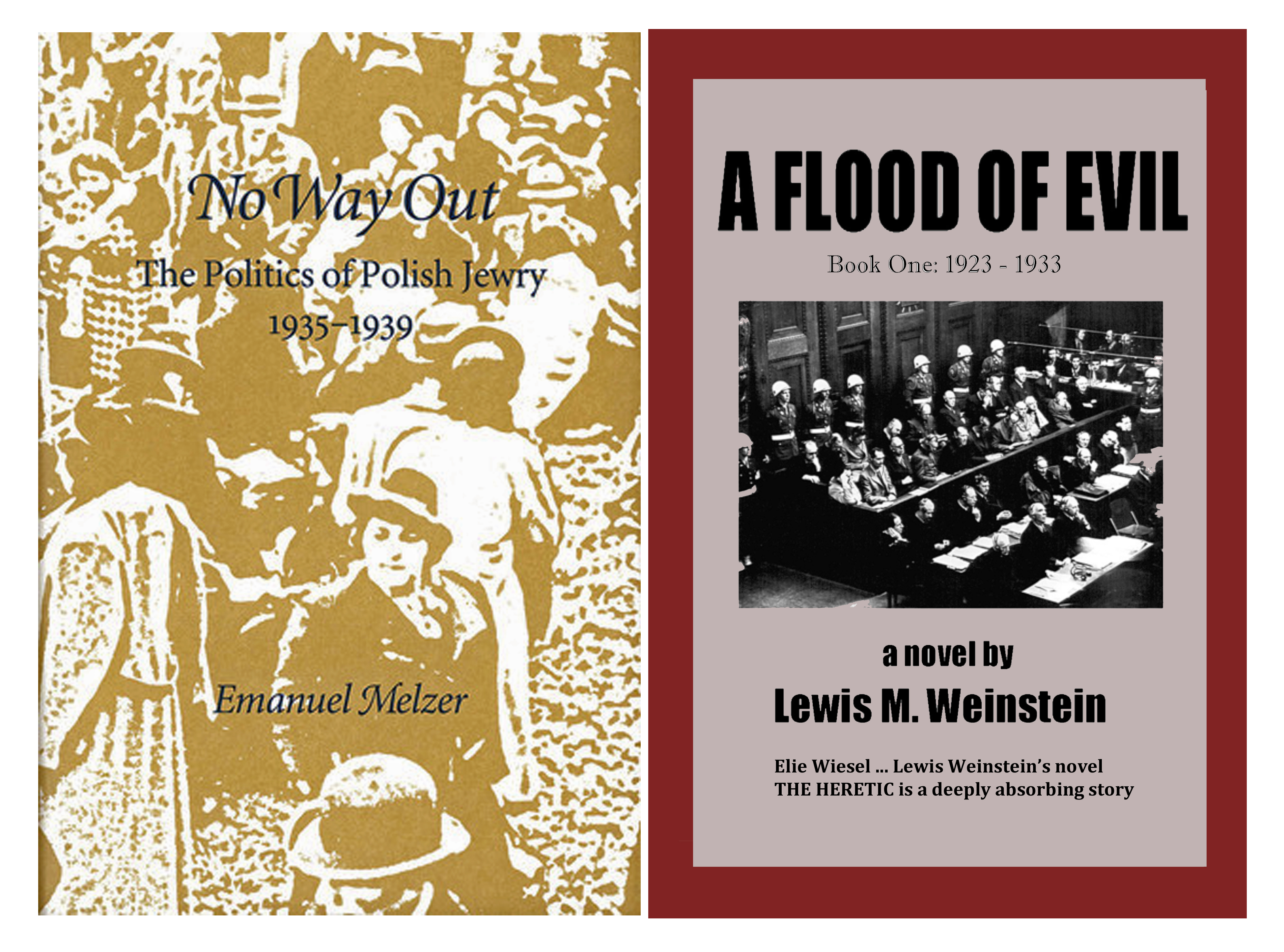
NOTE: As I await a decision on the publication of A FLOOD OF EVIL, I have been accumulating research which will be used in Volume Two of my novel, which I hope to begin drafting this summer.
NO WAY OUT …
This is a sad book, telling the story of the inexorable squeezing of the lives of 3 million Jews by the Polish Christian population after Marshal Pilsudski’s death in 1935. Fomented by right wing politicians and the Catholic Church, this accelerating Jew-hatred was much like what was taking place in Nazi Germany at the same time. There were some exceptions among Christian Poles, but not many. Most Poles wanted the Jews to leave but there was no place for them to go, particularly as the British lowered quotas for Polish Jews to emigrate to Palestine. The net result was a huge level of indifference when the Nazis conquered Poland, rounded up all the Jews, and murdered them at Auschwitz and other places.
Melzer’s book provides much detail on the economic and social persecution of Polish Jews, both through governmental actions and by unchecked violence.
Posted in *** Uncategorized | Leave a Comment »
* Lew’s comments on “The Catholic Church and Nazi Germany” by Guenter Lewy
Posted by Lew Weinstein on May 4, 2016

This is a very difficult book to read, both because of the material and also Lewy’s complicated style of writing, which sometimes seems as circuitous as the Catholic pronouncements he is presenting and explaining. Nevertheless, it is a treasure of information.
Lewy’s bottom line conclusion is damning …
Although a few priests and even fewer bishops tried to oppose Hitler and his annihilation of Jews, most did not. The Church as an institution did nothing. The fundamental reason for this was the Church’s centuries-long denunciation and persecution of Jews, which locked its own position and that of German Catholics into an attitude of indifference to the plight of Europe’s Jews.
In the final analysis, Pius XII did not disagree with Hitler that the Jews were a menace to be eliminated. There is no evidence that Pius XII condoned Hitler’s mass murder of Jews, but neither did he say a single word to condemn it. Lewy’s conclusion, and mine, is that this was a total and disgraceful abdication of the Church’s pretension to moral authority.
Cardinal Faulhaber of Munich, who is a character in my new historical novel, appears many times in Lewy’s book, and thus I have gained many opportunities to raise questions in my novel as to what Faulhaber thought as he dealt with his Church’s appropriate role and his own personal dilemma.
Posted in *** Uncategorized | Leave a Comment »
* Lew’s review of “The Gestapo and German Society: Enforcing Racial Policy 1933-1945” by Robert Gellately
Posted by Lew Weinstein on April 25, 2016
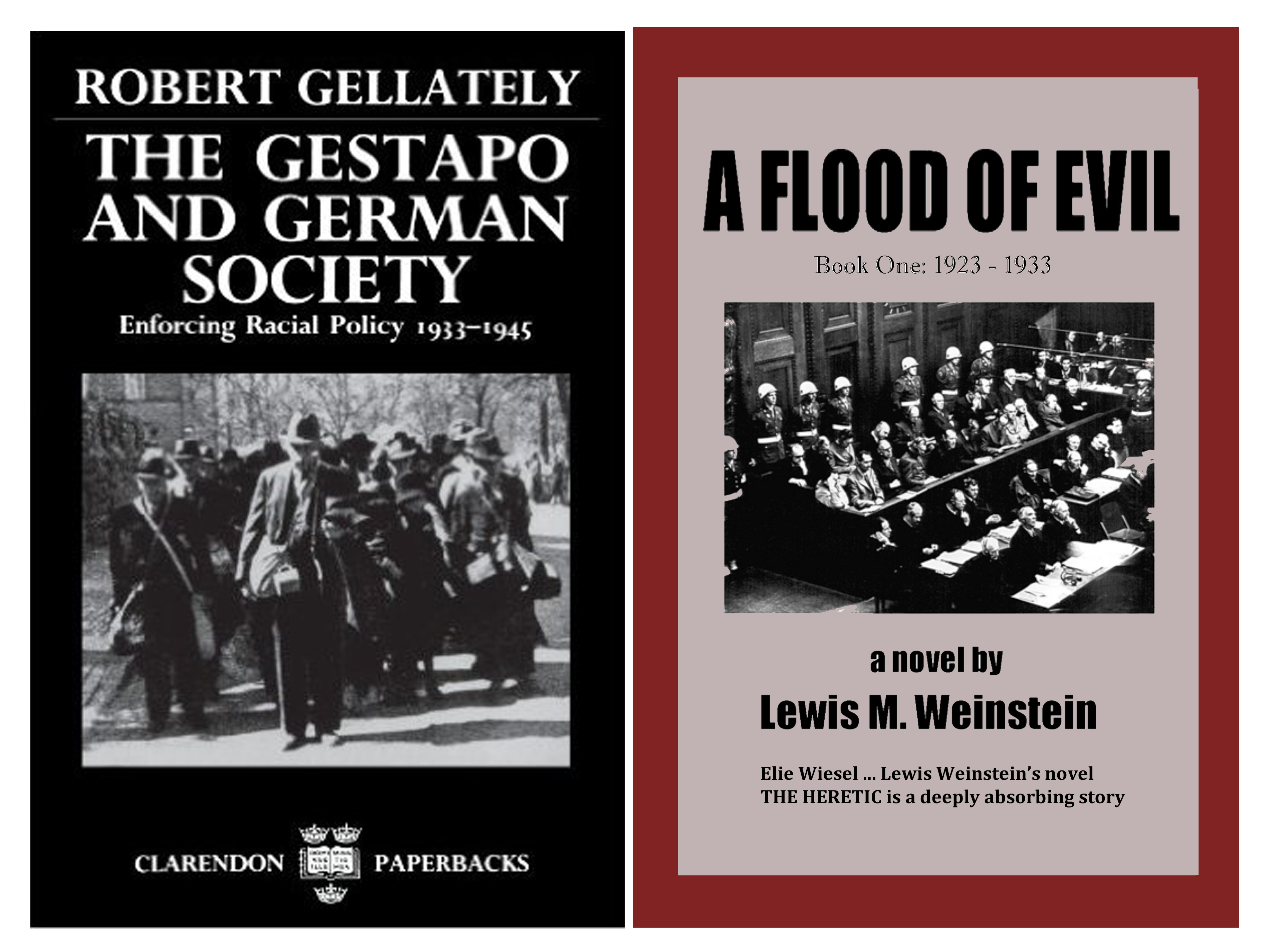
***
A truly excellent and detailed portrayal of how the Gestapo enforced German anti-Jewish policies and how ordinary Germans played a crucial role by denouncing their friends and neighbors. Some excerpts …
… Germans have been convincing themselves, in hindsight, that there was an extensive army of Gestapo agents and spies which allowed no opportunity for any real resistance or opposition to have crystallized … Gellately says that story is no longer convincing
… ordinary German citizens played a key role in their own policing and help make possible the murderous deeds of the Nazi regime
… the Gestapo’s reputation for brutality … and the knowledge that anyone could be sent to a concentration camp for an indefinite period … was central to the Gestapo’s effectiveness
… police now had the authority to arrest and detain any suspect deemed a threat to the state … with no judicial procedure or permission … this could amount to unlimited trial, indeed without even charges
… Gestapo cases were organize into many categories … continuation of political parties … continuation of forbidden religious associations … forbidden youth groups … nonconforming verbal utterances … nonconforming work or leisure activities … acquiring or spreading of forbidden printed matter … listening to foreign radio … political passivity … conventional criminality … improper statements from the pulpit
… Jews were made to feel that they could expect little help from their neighbors … that anti-Jewish policies would increase in number … and enforced down to the smallest detail … any sympathy that might be shown by any other person for their plight or even regarding the efficacy of anti-Semitic policies could be treated by anyone who wished to as cause for a report to the local Gestapo authority
… there was a high incidence of false charges … but the Gestapo could use intimidation,, extortion and blackmail to force victims to sign confessions … Gestapo interrogation was often exhausting for the victims … days and weeks filled with terror and anxiety … some, when released temporarily, attempted suicide to escape the relentless cross examination by the tireless officials
… sexual intercourse between Jews and non-Jews was declared a crime by the Nuremberg laws of 1935 … even friendly or social relations with Jews constituted an area of potential criminality
… a life-threatening incident could begin anywhere and at any time … a group was listening to dance music on the radio at a bar … the music was interrupted by a speech by Hitler … somebody turned off the radio … a woman immediately try to ascertain the name of the person who did that … the radio was turned back on but the lady was not satisfied and made a report to the Gestapo
… an elderly couple, a Jewish merchant and a woman who lived across the street from him, we’re suspected of having a relationship which might be considered raise the file … although the advanced years of both parties suggest that they fear of race defilement through production of a child of next ancestry was out of the question … nevertheless remarkably dogged and sometimes ridiculous efforts were pursued until the man died suddenly of natural causes … or did he commit suicide?
… sometimes there were not enough cases of race defilement … Gestapo officials had to invent more cases … Jews were lured into compromising situations and then denounced … or so called evidence was simply invented … to local Gestapo officers it was a foregone conclusion that every Jewish person brought to their attention could be linked with some infringement of race regulation
Posted in *** Uncategorized | Leave a Comment »
* a selection of photos from AN EVENING WITH FRANK
Posted by Lew Weinstein on April 20, 2016
20 never-before-published photos of Sinatra in concert
AN EVENING WITH FRANK is available at amazon …
Posted in *** Uncategorized | Leave a Comment »
* Update: A FLOOD OF EVIL is now in the hands of 5 agents
Posted by Lew Weinstein on April 16, 2016
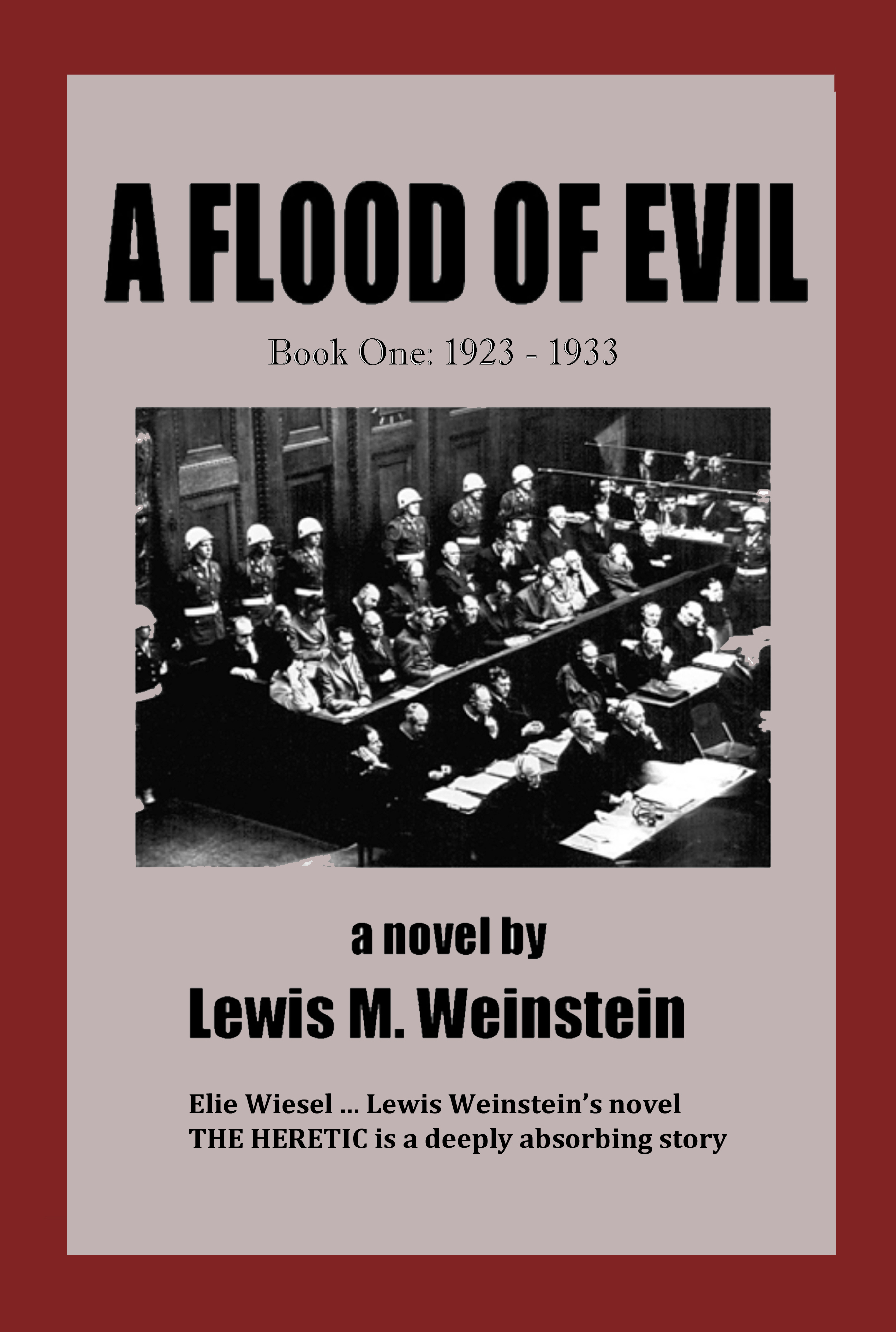
***
A month or so ago, I was just about to publish A FLOOD OF EVIL as a POD book on amazon. But first I thought I would try to find an agent to represent me and sell the book to a real publisher. I sent out letters to agents who seemed interested in historical fiction and now 5 agents are reading my book. Doesn’t mean anyone will sign me up, but it is encouraging. For the moment, POD publishing is on hold.
Here is a synopsis of the book the agents are reading …
A FLOOD OF EVIL opens with a Nazi named Berthold Becker on trial at the Nuremberg War Crimes Trials shortly after the end of WWII. He is saved from a certain death sentence by the unexpected testimony of a Polish Jewish woman named Anna Gorska.
Years later, the Nuremberg prosecutor and his daughter, now a history professor at Brandeis University, decide to work together on a book about the two people from his trial. They locate Berthold in Munich and Anna in Jerusalem and travel to them to learn their stories.
The reader meets Berthold, a Catholic, when he is thirteen years old and first exposed to the Nazis by his older brother. When the brother dies in Hitler’s failed beer hall putsch of 1923, Berthold is forever-after revered as the putsch martyr’s brother. As a result, even though he is repulsed by the Nazi violence and Jew-hatred, he is drawn into the Nazi orbit and gains unique access to the internal workings of the Nazi movement at the highest level.
Anna Gorska grows up in a Polish shtetl where her Orthodox Jewish family struggles against the forces of modernization. She leaves the shtetl to attend Warsaw University and, aided by her family’s connections with Polish strongman Josef Pilsudski, becomes a respected journalist with an international following.
Anna is sent to Munich to do a story on Jewish students in German universities. She meets Berthold and he offers to help with her student interviews. They fall in love and begin a lifetime of working together under severe duress to try to stop Hitler and the Nazis.
Through these characters, we meet many of the Nazi insiders, and also the people and institutions who could have stopped Hitler, but didn’t.
We learn Berthold and Anna’s stories not only from their recollections, but also by meeting them in “real time,” in the presence of the Brandeis professor and her father. Berthold and Anna, still sharp and intense in their 80s, thus provide the reader with a direct, first-person connection to supplement and comment on the story as they lived it.
A FLOOD OF EVIL is planned as a multi-volume historical novel. Book One, which is self-contained, begins in 1923 and ends shortly after Hitler became Chancellor of Germany in 1933.
Posted in *** Uncategorized | Leave a Comment »
* new titles … Sinatra is here … Hitler’s evil is coming
Posted by Lew Weinstein on April 15, 2016
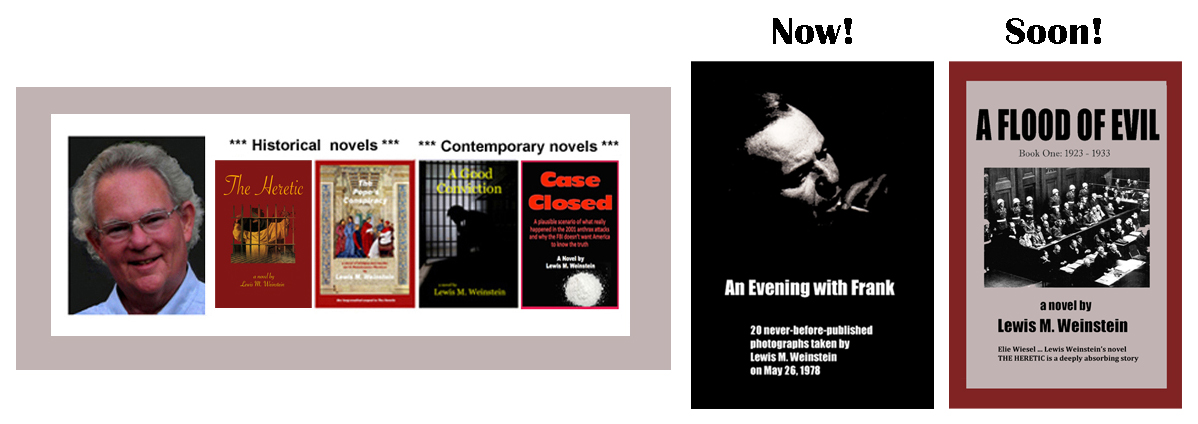
Posted in *** Uncategorized | Leave a Comment »
* Lew’s review of “In Hitler’s Germany” by Bernt Engelmann
Posted by Lew Weinstein on April 6, 2016

An excellent source for small details of how people reacted to the organized state terror of the Nazi regime. Some actually resisted, secretly to avoid being sent to concentration camps or killed. Others saw themselves as small cogs in a big machine, the overall objectives of which they supported. Still others denied knowing anything, although that was clearly impossible.
The sections dealing with Kristallknacht are particularly poignant, including the fate of one relatively low-ranking planner, who sent out orders to attack and destroy and murder Jews, and who, subsequent to a brief imprisonment by the Allies after the war, retired on a “fat pension” since he had been promoted to the rank of General in the Waffen-SS.
Six million dead; this Nazi pig retired on a fat pension!
Posted in ** RESEARCH for A FLOOD OF EVIL, *** Uncategorized | Leave a Comment »
Lew’s review of “The Hidden Encyclical of Pius XI” by Georges Passelecq … and some thoughts regarding the bounds of historical fiction
Posted by Lew Weinstein on April 2, 2016
In June of 1938, Pope Pius XI asked an American Jesuit priest to prepare a draft of what the Holy Father expected to become a Papal Encyclical denouncing the racial policies and antisemitism of the Nazis. Father LaFarge went to Paris and prepared such a draft, which he brought to Rome in September 1938. What happened next to that draft is not known.
A few months later, in February 1939, Pius XI died and in March 1939 Cardinal Pacelli became Pius XII. The Encyclical was never promulgated and in fact disappeared for decades.
Passelecq managed to obtain the draft and much but not all of the record related to it. Many important facts are likely still buried in Vatican archives, or perhaps destroyed, but what Passelecq obtained is enough for a fascinating story and even more fascinating questions.
Did Pius XI ever see the draft? Was it kept from him, and if so, did Cardinal Pacelli have anything to do with that? Did Pacelli see the draft? Did Pacelli decide to bury it and if so why?
Questions like these can perhaps be answered some day if the Vatican provides all the archives it has. Other questions are more speculative.
Would the Encyclical, if published, have made any difference in the Nazi’s subsequent murder of 6 million Jews? Would the Encyclical have created an anti-Nazi climate where the US might have entered the fight with England sooner? Would the Encyclical have created pressure for Allied bombing of Auschwitz and other murder sites? Would the Encyclical have led to Nazi retaliation against Catholics living in Germany, Poland and elsewhere? Would the Encyclical have encouraged other countries to allow more Jews to get out of Germany before they were murdered?
For me, Passelecq’s book provides much material for one or more possible chapters in Book Two of A FLOOD OF EVIL which I hope to write later this year.
THOUGHTS REGARDING THE BOUNDS OF HISTORICAL FICTION
But what are the appropriate rules for writing historical fiction when some of the facts are known and others are not? My guidelines are these:
(1) if I state an historical fact, get it as right as possible;
(2) if responsible sources disagree on the facts, I am free to choose whichever version I want to portray;
(3) for the fictional parts which go beyond the known facts, they must be plausible with regard both to known events and to the reported personalities and inclinations of the historical characters;
(4) there must be no credible negative facts which make the fiction I am writing impossible to have happened.
Given those guidelines, I feel free to create a work of historical fiction which goes beyond the history and presents a plausible version of what might have happened. “The Hidden Encyclical of Pius XI” gives me a huge and powerful canvass on which to create important aspects of my novel.
Posted in ** RESEARCH for A FLOOD OF EVIL, *** Uncategorized | Leave a Comment »
* Lew’s review of Days of Sorrow and Pain: Leo Baeck and the Berlin Jews by Leonard Baker
Posted by Lew Weinstein on March 27, 2016
Rabbi Leo Baeck was perhaps the most important leader of the Jews of Germany during the Hitler years. A scholar and spiritual leader before Hitler’s rise, Baeck turned down offers to leave Germany and took on the difficult and ultimately frustrating role of coordinating Jewish response to the closing Nazi net. Arrested several times, he survived Theresienstadt and lived his final years in England. Baker has written a marvelous account of Baeck’s long and remarkable life.
Baeck recognized that the scattered organizational structure of German Jewry was not adequate to stand against Nazi antisemitism. He helped create and was the chief spokesman for the Reichsverretung, an organization which supervised welfare problems of German Jews … education … emigration … raised funds … and sought help of Jews abroad. He was a major factor in the escape of many German Jews during the late 1930s when escape was still possible.
In 1935, on Yom Kippur shortly after the passage of the infamous Nuremberg Racial Laws, Baeck wrote a stirring sermon to be read in all synagogues in Germany. In this sermon, Baeck stated … that there was a moment of decision for each individual, the point beyond which he will not bend, the pressure to which he will not succumb, the sacrifice he will not make … that Judaism was the history of the grandeur of the human soul and the dignity of human life … that no matter how weak we are, how oppressed we might be, how abruptly our former friends turn away from us, we cannot be defeated.
Baeck was arrested by the Gestapo, but soon released after pressure from an article in the London Times and protest from a group of Christian ministers in the US. Baker points out that “no German Christian leaders protested the Baeck’s arrest.”
This event, and others in Baeck’s life, will likely play a role in Book Two of my novel A FLOOD OF EVIL.
Posted in ** RESEARCH for A FLOOD OF EVIL, *** Uncategorized | Leave a Comment »
* Lew’s review of The Face of the Third Reich: Portraits of the Nazi Leadership by Joachim Fest (chapter on Reinhardt Heydrich)
Posted by Lew Weinstein on March 27, 2016

Joachim Fest has created fascinating, terrifying portraits of the major figures in the Nazi leadership.
I just read the chapter on Reinhardt Heydrich, described by Fest as … the architect and brain behind the SS state … a man free from humanitarian restraints … with an insatiable greed for power … and unencumbered by either ideologies or emotions.
Heydrich was the man who fashioned the Final Solution to murder all the Jews of Europe. Yet, according to Fest … Heydrich lived under the continual constraint of his own Jewish ancestors … he tried to destroy all the evidence … but was unable to prevent enemies and rivals from obtaining documentary evidence.
Fest states that Heydrich went so far as to change the headstone of his grandmother’s grave so that it said ‘S. Heydrich’ rather than ‘Sarah Heydrich.’
According to Fest … Himmler & Hitler were aware of Heydrich’s Jewish ‘problem’ … they regarded Heydrich as gifted but dangerous … and felt their knowledge of his ancestry would keep him in line … he will obey blindly.
It is important to note that Fest’s views on Heydrich’s Jewish ancestry are not universally accepted by other historians.
Heydrich is introduced briefly in Book One of my soon-to-be-published novel A FLOOD OF EVIL, and it is my intent that he will be a major character in Book Two, which I have begun to research and outline.
Posted in ** RESEARCH for A FLOOD OF EVIL, *** Uncategorized | Leave a Comment »
* Lew’s review of JUST MERCY by Bryan Stevenson
Posted by Lew Weinstein on March 20, 2016

***
JUST MERCY is a ringing denunciation of the way prosecutors, police officers and judges conspire to get convictions without having the evidence.
How do they do this? They cheat.
They make up evidence. They create and intimidate witnesses by threats and bribes. They hide exculpatory evidence they are required by law to give to the defense attorney.
These public officials are a disgrace to American law enforcement and they are almost never punished for their behavior, even when those they wrongly sent to prison are released 10, 20 or more years later, their lives ruined.
Bryan Stevenson writes as well as the top mystery novelists, except his stories are true. He is the executive director of the Equal Justice Initiative in Montgomery, Alabama. (http://www.eji.org/) which works to help correct the horrors of children sent to prison without possibility of parole, people on death row whose convictions are a travesty of justice, and minorities who do not get anything close to fair and equal treatment. The book presents examples of each of these kinds of cases. Stevenson’s cases take place in the south, but the problems he describes are found everywhere in America. Meeting these people will make you cry. It could happen to you.
I have studied and written about these matters in my novel A Good Conviction. John Grisham’s Rogue Lawyer covers much of the same territory. Our fiction is based on real cases, but Bryan Stevenson gives it to you straight, from real life, recent cases, still happening.
Posted in * A GOOD CONVICTION, *** Uncategorized | Leave a Comment »
* Coming soon … An Evening with Frank
Posted by Lew Weinstein on March 18, 2016
On May 26, 1978, I attended Frank Sinatra’s last appearance at the Latin Casino in Cherry Hill NJ. Seated near the stage, I shot one roll of ASA 400 black and white film. It took about 25 minutes from start to finish.Sometime that summer, my friend Susan Rose developed the film and printed the photographs.
For almost 38 years, these photos have been in file folders, in drawers, and for the past eight years, in my garage.
Remarkably they have survived.
Posted in *** Uncategorized | 2 Comments »
* Lew’s books at Books and Books
Posted by Lew Weinstein on March 4, 2016
Great news! All of my titles are now available at Books and Books at 533 Eaton St in Key West. Even “Hereje,” which is “The Heretic” in Spanish. But not A FLOOD OF EVIL, which is not yet published (soon!).
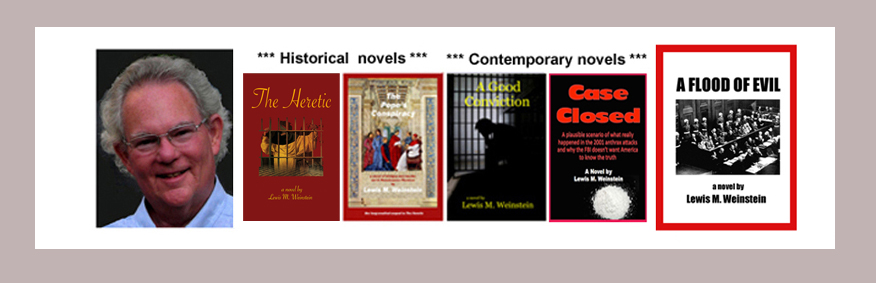
Posted in *** Uncategorized | Leave a Comment »
* Monsignor Tom Hartman
Posted by Lew Weinstein on February 21, 2016

Monsignor Thomas Hartman – Father Tom – died this weekend. I first met Monsignor Hartman at the 92nd Street Y in NYC where he opened his talk by saying “The Church did horrible things to the Jews and we were wrong.” Subsequently, he wrote a very thoughtful foreword to my novel THE HERETIC. Father Tom was everything good that a priest can be, a model not just for Catholics, but for all human beings.
***
Foreword to The Heretic by Msgr. Tom Hartman
The Heretic reminds us of a history
that we should not forget.
Marc Gellman and I rarely disagree. We’re best friends. There are many best friends in the world, but the fact that he is a rabbi and I am a priest has caused some people to sit up and take notice. People see us on Good Morning America or Imus In The Morning or our own God Squad show. We try to look out at our world and find a reason for hope which cuts across our respective religious faiths and gets to the heart of spiritually responding to God and our neighbor. We’ve been at this for thirteen years and our disagreements and tense moments have been few.
Marc and I had it out one evening at a local television station. We were talking about the convent at Auschwitz. I was incensed. A Jewish rabbi – Avi Weiss – and a group of his followers had jumped over the convent wall to pray in protest. This startled and frightened the group of contemplative nuns who had built the convent at Auschwitz to pray for the victims of the Holocaust. “How,” I asked Marc “can you or any other Jew support such an action? If Jews knew anything about these sisters they would realize that they were selfless, holy, and prayerful. They were committed to redeeming the ugly face of mass murder and destruction.”
Marc listened. His face told me that he was searching for a way to share something painful with me in a caring way. He turned, looked me in the eye, and said, “Tom, you don’t realize what the Cross of Jesus means to us Jews. For you the Cross is a sign of hope and redemption. For us it’s a sign of despair and destruction. It was during the Inquisition and the Crusades that Christians led with the Cross as they murdered thousands of Jews. They killed Jews and Muslims in the name of the Cross. Pogroms raped and pillaged our people in the name of vengeance toward the Jews that killed Christ.” Marc’s own aunt had once been abused by people leaving a Holy Week service looking for a Jew to vent their anger toward for the death of Jesus.
I didn’t realize the depth of his feelings on the subject until we did that show. It took me aback. That which was a sign of hope and redemptive love for me – the Cross – was a sign of destruction for him. Recognizing this for the first time, I could see why a Jew would be offended at the sight of the Cross at the scene of one of the greatest massacres of Jewish people in human history. I turned and said, “Marc, if that’s what the Cross represents to Jews, maybe we ought to take it down.” “No,” said Marc, “maybe we ought to build a synagogue next to the convent and we could both pray together.”
The Heretic, a book by Lewis Weinstein, was where I turned in order to understand the Inquisition. I knew the outline of Christian atrocities but Lew’s book taught me about the painful positions many good people were put into in order to survive. It’s not a pretty picture. Their lives were all scarred in one way or another. But The Heretic reminds us of a history that we should not forget.
***
link to obituary in NYT …
Posted in * THE HERETIC, *** Uncategorized | Tagged: Monsignor Tom Hartman, The Heretic by Lewis Weinstein | Leave a Comment »
* Lew’s Goodreads review of “The Twisted Road to Aushwitz” by Karl A. Schleunes
Posted by Lew Weinstein on January 13, 2016

This is one of the first books (published in 1970) to put the persecution of Jews by the Nazis into a sequential narrative context, and it is still valuable today even after many other works have added information not available to Schleunes.
The Nazi efforts to achieve the Jew-free Germany demanded by Hitler are described as a series of vicious programs which failed, from 1933 to 1938, to accomplish Hitler’s goal. Boycotts, legislation, emigration and pogroms all caused incredible hardship but still failed to eliminate Jews from Germany or even from the German economy. Finally, after Kristallknacht in November 1938, Hitler turned the Jewish problem over to Goering, Heydrich and Eichmann, which led to Auschwitz.
Schleunes argues that Nazi policy until late 1938 was implemented by various underlings acting without consistent direction from Hitler. From what I have so far read, I think this was true but not a complete analysis. Hitler’s fanatical Jew-hatred never wavered, from the moment he came to public attention in the early 1920s until his last statement before he died in 1945. But Hitler was patient, and his career is marked by a willingness to wait for the right opportunity and to defer action on one priority – ridding Germany of Jews – while focusing on the then-higher priorities of economic recovery and rearmament. When those goals had been achieved, and Germany no longer needed to be concerned with international opinion, Hitler turned to the Jews.
One aspect of the Nazi Jew-hatred that Schleunes does not address is why Hitler hated and feared Jews as he did, and why so many (most?) Germans had no problem accepting that hatred as valid and acquiescing in Hitler’s policies, even to the point of mass murder. Why were Jews hated? Where did Hitler acquire that hatred? Why was persecution of Jews so acceptable to so many Germans? These are issues I am dealing with in the almost completed A FLOOD OF EVIL (1923-1933) and the sequel which is now taking focus.
Posted in ** RESEARCH for A FLOOD OF EVIL, *** Uncategorized | Leave a Comment »
* A Flood of Evil … update
Posted by Lew Weinstein on December 26, 2015

I have completed a major revision and tightening of the entire draft and it is currently in the hands of “early readers.”
Thanks so much to all of the early readers who have already read portions of my novel and provided valuable comments.
Here’s my first draft of a book jacket description. Your comments are welcome …
A FLOOD OF EVIL
Do you believe it’s impossible for another Hitler-like menace to emerge in Europe or the United States? Actually, there are conditions today that provide frightening parallels to those in the Weimar Republic in the 1920s and early 1930s. It is important for all of us to understand how Hitler came to power, how his rise could have been stopped, and who chose not to oppose him.
Lewis Weinstein has written a bone-chilling novel that explores these issues through the eyes of two young people, one a German Catholic and the other a Polish Jew, who were extraordinarily positioned to understand what was happening as they worked with powerful people in both countries who sought to keep Hitler from power.
Berthold Becker was drawn into the Nazi orbit because his older brother was viewed as a martyr who had saved Hitler’s life in the 1923 Putsch attempt. He sees the leaders of the Nazi world from the inside.
Anna Gorska leaves her Polish shtetl and becomes an internationally respected journalist with access to the powerful.
Berthold and Anna fall in love and work together in a dangerous and ultimately futile quest to keep Hitler from power.
A FLOOD OF EVIL takes place in the years from 1923 to 1933, from the beginnings of the Nazi Party to Hitler’s appointment as Chancellor.
***
Posted in *** Uncategorized | Leave a Comment »
* a new review of THE HERETIC
Posted by Lew Weinstein on November 21, 2015
Linda’s review of THE HERETIC on GoodReads (Aug 2015) …
A well written story that will pull at your heartstrings because of the amount of loss and betrayal that occurs when the Catholic Church decides there can be no other religions to compete with them in Spain.
Gabriel Catalan and his family live in Seville where they are called Conversos because they converted to Catholicism to save their family from the torment they would get as Jews. However, Gabriel and a number of other Conversos are secret Jews. Many Catholics do not trust them yet the Conversos have been the ones to keep the country running smoothly. When the Spanish Inquisition begins Gabriel and his family as well as many friends are at risk of being caught in their secret lives and being put to death. This does not stop Gabriel and his son Tomas from hiding Gutenberg Printers so that they may print volumes of Jewish books for the future. There is hope among the Jewish population that things will one day be very different.
As I read this story I kept thinking about the present state of our world and how we seem to be becoming less tolerant again. We were supposed to have learned from the past but we seem to be ignoring it and in some cases pretending that it never happened. How sad for our future generations.
I believe that everyone should read this book as a reminder of what was and what should now be. When we think of intolerance, Hitler and the Nazis always come to mind but there is a whole lot more in our history than that. My hope for mankind is that someday everyone will “give peace a chance” and I believe this story is trying to lead us in that direction.
Posted in * THE HERETIC, *** Uncategorized | Leave a Comment »
* Lew’s comments on “Once We Were Brothers” by Ronald Balson
Posted by Lew Weinstein on September 7, 2015
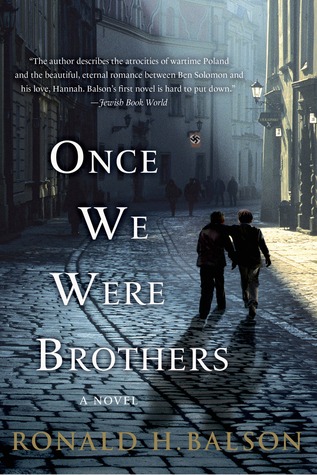
A compelling read.
Several issues raised by Balson resonate sharply with me as I work through similar questions in my own new novel.
WARNING … POSSIBLE SPOILERS BELOW
,,, Ben hates his former friend and “brother” Otto for failing to save his parents and others from Nazi torture and murder but gives no credence to the enormous risks Otto did take to save Ben and his wife, the unsuccessful but still substantial efforts Otto made on behalf of others, and the numerous warnings he made for all of them to leave Poland while they still could. In the scenes where Otto was complicit in the murders, it seemed clear from Balson’s description that Otto’s only alternative was to try to save them and fail, and in the process commit suicide.
… What could Otto have done? What could any of the small cogs in the Nazi machine have done? Collectively, of course, tens of thousands of Germans could theoretically have refused to carry out Nazi orders, fomented or carried out revolution against Hitler, or fled Germany. Whether such actions were actually possible is highly questionable, but even if successful, they would likely have meant the deaths of the perpetrator’s families and neighbors.
… There should be a distinction, it seems to me, between patriotic actions in furtherance of national war aims and actions that were later termed, correctly in my view, war crimes. Should a patriotic German at a relatively low level in the army or even in the SS or Gestapo be held accountable for failing to distinguish the line between fighting for his country and committing acts against humanity (as later defined at the Nuremberg Trials)? I say yes, the line was clear enough, but the more difficult issue is whether you are obliged to risk not only your own life but also the lives of your own family, especially if you think your protest has no chance to succeed.
Balson raises all of these issues, and more, in stark dramatic form. A very good story.
Posted in *** Uncategorized | Leave a Comment »
* reviews of THE HERETIC on Goodreads … I have to admit I love to read these reviews … thanks to everyone for your kind words
Posted by Lew Weinstein on August 16, 2015


Cathy DuPont rated it 4 of 5 stars
Recommends it for: Everyone who enjoys a great story told well.
If I kept a GR shelf for family sagas, this book would be proudly placed there along withThe Pillars of the Earth, Gone With the Wind, and The Age Of Innocence. In my mind they are all historical novels which describe families and their trials and tribulations of living in troubling and/or interesting times.
This historical fiction was set during the Spanish Inquisition which I knew little about. During this inquisition under Queen Isabella and King Ferdinand of Spain in the late 1400’s and ear …more

Chuck rated it 5 of 5 stars
The author, Lewis Weinstein, is one of my Goodreads friends. Outstanding job, Lew. Historical fiction is my favorite genre and this is historical fiction of the first order. It is very well written, exhaustively researched and historically accurate. This book increased my knowledge of the religious conflict in 15th century Spain by one hundred fold. The folks writing positive acknowledgements about the book include Elie Wiesel, Alan Dershowitz and Faye Kellerman. It tells the story from
the view …more
the view …more

Paul Fadoju rated it 4 of 5 stars
A touching well written book. Set during the Spanish Inquisition it shows the beautiful portrayal of a Jewish Family as they try to live in a culture that denies their humanity. I was touched with the tapestry of their lives, the length they went to live the lives that was true to themselves….and as you go through their struggles, you ask yourself a simple question what would I do in their situation. This ugly part of the Christian history is not well known to the modern church and it’s nice t …more

An historic telling of the treatment, by the Catholic church, of the Jews in Spain, leading up to the period of the Spanish inquisition. I have read a number of books about the annihilation of the Cathars and other religious groups by the Catholic Church, and I had realized the Jews were also persecuted by the church, but this story explores not only the actions of the church, but also the tenacity and resourcefulness of the Jewish people. A slowish read but a thoroughly interesting story.

I approached The Heretic with a small amount of trepidation because, as a gentile, I wasn’t certain that I would follow the passages of the explanation of the Jewish faith which I knew to be contained in the book.
In the event I needn’t have been concerned at all. Yes there was much of what I expected but all of this was wrapped around a thrilling and superbly told story and added strength to what Lewis Weinstein was trying to achieve; to give readers a complete understanding of how and why the J …more
In the event I needn’t have been concerned at all. Yes there was much of what I expected but all of this was wrapped around a thrilling and superbly told story and added strength to what Lewis Weinstein was trying to achieve; to give readers a complete understanding of how and why the J …more

I loved this book! Tells a part of European history I knew little about. “The Heretic” explains the rationale of the Catholic Church used to persecute the Jews of Spain. Lessons for our own time. I want to learn more about the Spanish Inquisition period so I am now reading the newly released book “Isabella The Warrior Queen” by Kirstin Downey. Looks to be another very interesting book.

Judie rated it 5 of 5 stars
I would assume that most people who consider reading THE HERETIC are familiar with the details of that tragic period of Jewish and Catholic history. While Lewis Weinstein’s scholarly novel does give the usual details about the predetermined trials, the tortures, and the burning of its victims, particularly at the end of the book, THE HERETIC goes much deeper into its causes.
Gabriel Catalan ’s Jewish father was forcibly converted to Catholicism,thus becoming a converso. While some Jews were abl …more
Gabriel Catalan ’s Jewish father was forcibly converted to Catholicism,thus becoming a converso. While some Jews were abl …more

Lisa rated it 5 of 5 stars
This historical novel is well-researched and the story is captivating, although difficult to read in places because of the terrible violence perpetrated against Jews and forcibly baptized Christians (and their descendants) suspected of “reverting” to Judaism in medieval Spain. The author captures well the dangers in the lives of these conversosand, for those who wish to live as Jews, the risks they ran to practice their faith and be true to their heritage. All of this is in the context of the l …more

What risks are your beliefs worth? During the Spanish Inquisition, this question permeates the lives of the Jews and conversos, those who had converted to Catholicism under duress. With noteworthy historical accuracy, Weinstein brings the fictional Catalan family and its nemesis Friar Perez, into the realistic world, one including Gutenberg, the father of the printing press, the infamously evil monk Torquemada, and various members of the royal families of the kingdoms of Spain that were not yet …more

I’m not sure where to start with my review of Lewis Weinstein’s ‘The Heretic’, so I’ll start by saying that it was a damn good read. I think that part of my problem here is that I read the sequel first, and while both books are very good works of fiction in their own right, there’s always a little less suspense when one knows, even in the broadest terms, what is going to happen down the line.
My misfortune aside, The Heretic is, like its sequel The Pope’s Conspiracy, a very well-written, historic …more

Fergie rated it 4 of 5 stars
The Heretic is a wonderfully written novel about the Spanish Inquisition and the impact it had on the Jewish population in the 15th century. In Lewis Weinstein’s able hands, the history of Jewish culture trying to survive the Anti-Semitic acts of that era survive. In fact, Weinstein describes with great deft, the roots of Anti-Semitic views in Europe.
I read this book in one day, finding it difficult to put down. History, action, and love all abound in this book. Also present is the notion of i …more
I read this book in one day, finding it difficult to put down. History, action, and love all abound in this book. Also present is the notion of i …more

A great read and strong reminders of how powerful fear can be in causing good people to hate each other. I also loved the deep loving marriages. The characters were very real, the dialogue honest, the descriptions vivit and the facts (historical and biblical) so well researched that I learned a great deal while enjoying a wonderful story. Thank you Lewis.

Diane rated it 5 of 5 stars
I found this book written about religious intolerance in Fifteenth-Century Spain interesting and informative and quite shocking. The descriptions of characters, costumes,scenery,landscapes and religious traditions made this book come alive for me.A Good read, this book really opened my mind about religious thought and dogma. I recommend this book to all.

I am Catholic. My entire life I have had friends that are Jewish. Until reading this compelling novel did I really understand their feelings towards Christianity. This book is a must read.

Patricia O’Sullivan rated it 5 of 5 stars
Gabriel Catalan’s father was stoned to death by a Christian mob despite converting to Christianity. As he nears middle age, Gabriel seeks to learn more about his father’s Jewish faith. Welcomed into a community of secret Jews, Gabriel is entrusted by them to learn the new art of printing from Herr Gutenberg himself so the Jews can preserve their sacred texts and encourage fledgling Jewish communities in Spain. As Gabriel’s fortunes rise, he hands over the printing operation to his son, Thomas, w …more

Thomas DeKooning rated it 4 of 5 stars
I finished The Heretic today. It is beautifully written and it is obviously carefully and thoroughly researched. The novel is a historical fictional account of the elimination of the Jewish population by the Catholic Church in Spain just before and during the reign of Queen Isabella. Moral questions are constantly put before the reader. Choices have to be made between religious commitment to the Jewish faith or to the safety and survival of the family. The wife and mother, Pilar, is much more in …more

Disturbing.

Stephen Embry rated it 5 of 5 stars
I would highly recommend Mr. Weistein’s story of Spain during the time of the reconquista and the inquisition. It captures the conflicts in a land populated by Christians, Jews and Musliims in a remarkably fresh way. At this time the the Christian princes and princesse were involved in a struggle to reconcile holy wars manifested by the crusades and jihad, in a way that is difficult to appreciate in modern terms, which are largely a response to the religious passions of the times.However, these …more

Ju rated it 5 of 5 stars
Wow. It took me awhile to actually read this book because when I first stumbled upon it, it wasn’t available on kindle. Then I waited because I needed fast moving books to keep interested with my busy life. Who says fast moving needs to be mindless? Couldn’t put the book down. Finished in two weeks and was sad when the story was over. Well written historical fiction. Reminds me why I love historical fiction. Characters are believable and so full of life and stories to tell. Helps bring clarity t …more

Madeleine Russo rated it 5 of 5 stars
Everyone, be you Christian, Catholic, Jewish….matters not this is a book which will open your eyes and broaden your knowledge of how religious persecution took place. You will be astonished at how religion was used to severly punish people – so times for no good reason. you owe it yo yourself to put this book as a must read..when you are done you will have a much better understanding of our human race. GREAT BOOK!

Laura Uplinger rated it 5 of 5 stars
Thank you Lewis Weinstein for this fabulous book!
It moved me so deeply… I admire your art and your research. “The Heretic” educated me, and the Catalan family now lives in my heart.
It moved me so deeply… I admire your art and your research. “The Heretic” educated me, and the Catalan family now lives in my heart.
Barbara rated it 4 of 5 stars
Shelves: five-stars
Excellent historical novel; don’t miss it!
Our reading group gave it 5 stars.
Our reading group gave it 5 stars.

Compelling read about conversos surviving on the eve of the Spanish inquisition. This was in limited release and hard to track down, but it was worth it.
Posted in *** Uncategorized | Leave a Comment »
* CASE CLOSED – Lew’s novel about the anthrax attacks and the failed FBI investigation – has been re-published. In this interview, Lew explains why perhaps his novel is closer to the truth than anything the FBI is asserting.
Posted by Lew Weinstein on July 24, 2015

Here is the link to the interview …
https://www.youtube.com/watch?v=8A2ybdHTziA
purchase CASE CLOSED at amazon … kindle $3.99, paper $14.95
Posted in *** Uncategorized | Tagged: 2001 anthrax attacks, CASE CLOSED by Lew Weinstein, FBI anthrax investigation | Leave a Comment »
* The new edition of CASE CLOSED could not come at a more opportune time.
Posted by Lew Weinstein on June 4, 2015
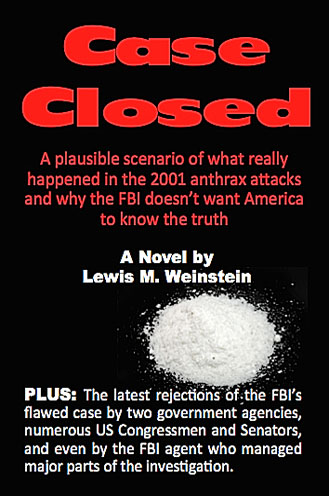
The new edition of CASE CLOSED could not come at a more opportune time.
Just a few days ago, on June 3, 2015, the Pentagon reported that 51 laboratories received shipments of live anthrax, across 17 states (plus D.C.) and three foreign countries over a period of at least ten years. The Defense Department admitted it didn’t know everywhere it had sent the toxic bacteria.
This is happening fourteen years AFTER the 2001 anthrax attacks that killed 5 Americans and paralyzed our country. What would you speculate about controls over anthrax BEFORE the attacks? Right, they were virtually non-existent.
Yet the FBI, in the face of no credible evidence of any kind, still insists that Dr. Bruce Ivins was the sole perpetrator of those attacks. The FBI’s case offers no physical evidence, no witnesses, no scientific evidence, and an impossible time line. Both the NAS and the GAO have conducted independent reviews which concluded the FBI’s claims to scientific evidence are not valid.
So we are left with two questions, both of which have important national security implications. Who really did carry out those attacks in 2001? Why does the FBI stick to its demonstrably false assertion?
CASE CLOSED offers a far more plausible scenario than anything the FBI says. The novel is told through the activities of a team of DIA investigators who re-trace the steps of the FBI, find many of the same flaws that have been exposed in real life, and then develop a scenario of why the FBI did not solve the case and who was responsible. This latter is of course fictional, but many informed readers, including one highly placed in the US Intelligence Community, have concluded that CASE CLOSED is more plausible than the story the FBI has concocted.
***
CASE CLOSED is available in paper ($14.95) and ebook ($3.99) at …
… amazon … (http://www.amazon.com/Case-Closed-Lewis-M-Weinstein-ebook/dp/B00YIC331Y/ref=sr_1_2?s=books&ie=UTF8&qid=1433425899&sr=1-2&keywords=weinstein+case+closed&pebp=1433438167533&perid=1M7V72CVS1R475C6A1CY),
… Barnes and Noble … (http://www.barnesandnoble.com/w/case-closed-lewis-m-weinstein/1016943061?ean=9780692452653),
… Absolutely Amazing Ebooks … (http://www.absolutelyamazingebooks.com/bookpages/caseclosed.html).
Posted in *** Uncategorized | Leave a Comment »
 Lew's AUTHOR BLOG